


Why Tax Planning Strategies Matter for Your Financial Success
Tax planning strategies are proactive, legal methods used throughout the year to minimize your tax liability. Unlike tax preparation, which is reactive, tax planning is an ongoing process of making smart financial decisions to reduce taxable income, defer taxes, and align your finances with long-term goals.
Key strategies involve:
- Maximizing retirement contributions
- Timing income and deductions
- Harvesting investment losses
- Choosing the right business structure
- Leveraging tax credits and deductions
- Using Health Savings Accounts (HSAs)
Effective planning turns tax obligations into a financial advantage. As one business owner noted, while taxes are a necessary part of a functioning society, nobody enjoys paying more than they must. Smart planning can ease that frustration.
I’m Michael J. Spitz, and with over 15 years of corporate accounting and strategic financial planning experience, I’ve helped countless clients implement effective tax strategies to optimize their financial outcomes. This guide will share proven approaches to reduce your tax burden and build wealth more efficiently.
Foundational Concepts: Deductions, Credits, and Brackets
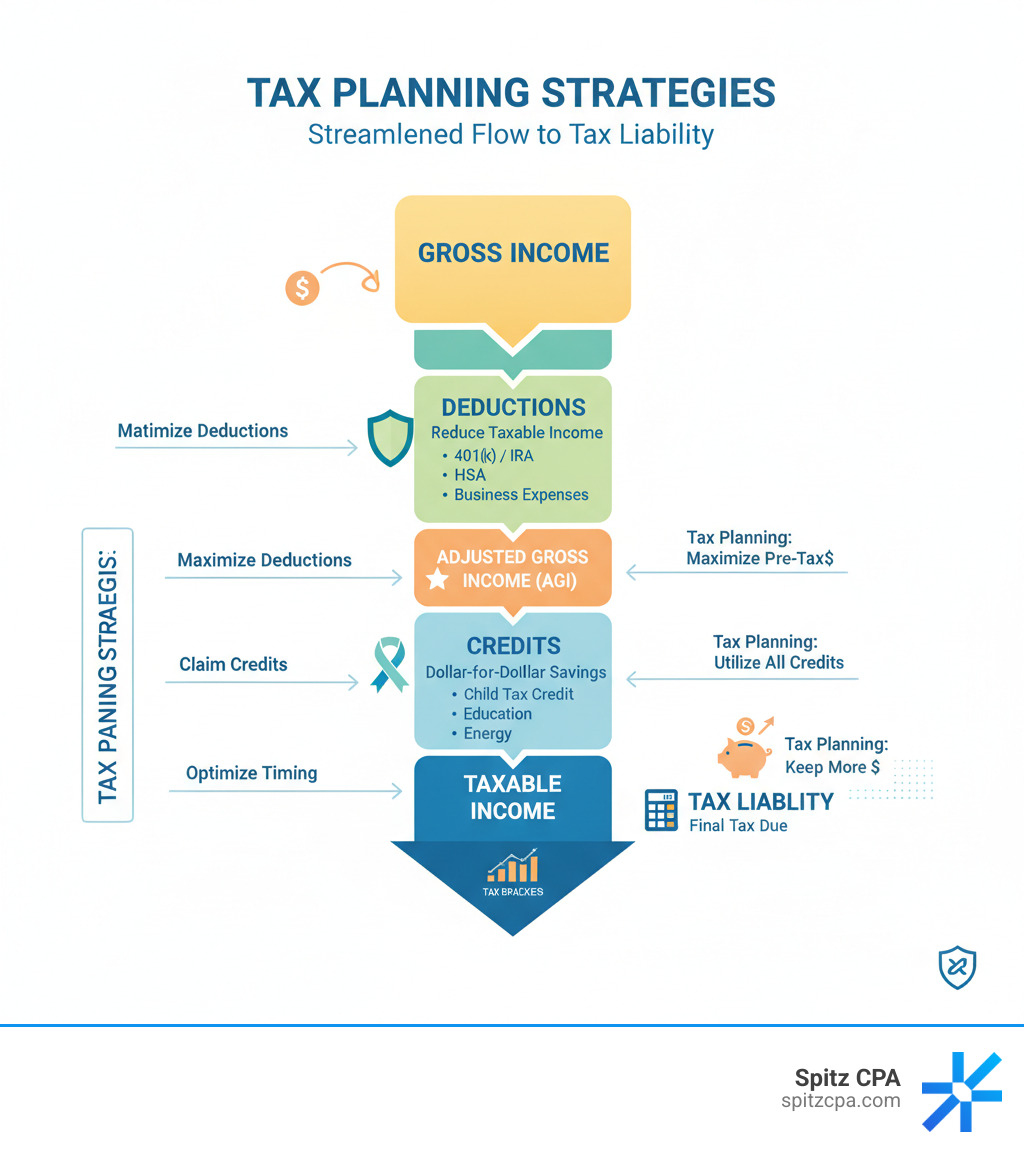
To use tax planning strategies effectively, you must understand the basics. The U.S. has a progressive tax system, where income is taxed in brackets at increasing rates. This means only the income within each bracket is taxed at that rate—not your entire income. For example, if you’re single with $50,000 in taxable income in 2025, only the portion above $48,475 is taxed at the 22% rate.
To reduce your taxable income, you can take the standard deduction (a fixed amount, e.g., $15,750 for singles in 2025) or itemize deductions on Schedule A. You should itemize if your specific expenses—like state and local taxes (capped at $10,000), mortgage interest, and charitable contributions—total more than the standard deduction. We help clients in Gilbert and Arizona determine the best approach.
Tax Deductions vs. Tax Credits: What’s the Difference?
Tax deductions and tax credits both save you money, but in different ways. A tax deduction lowers your taxable income, so your savings depend on your tax bracket. A $1,000 deduction in the 22% bracket saves you $220.
A tax credit is more valuable because it reduces your tax bill dollar-for-dollar. A $1,000 credit cuts your tax bill by the full $1,000. Some credits are refundable (you get the excess back as a refund), while others are non-refundable (they can only reduce your tax liability to zero).
Here’s a quick comparison:
| Scenario | $1,000 Tax Deduction (22% bracket) | $1,000 Tax Credit |
|---|---|---|
| Taxable Income Reduced | $1,000 | $0 |
| Tax Bill Reduced | $220 | $1,000 |
| Net Savings | $220 | $1,000 |
As you can see, credits pack a much bigger punch.
Popular Tax Credits and Deductions to Know
Knowing what you qualify for is key to not leaving money on the table. Here are some of the most valuable opportunities:
- The Child Tax Credit provides a significant credit for each qualifying child.
- The American Opportunity Credit helps offset the first four years of college tuition and can be worth up to $2,500 per student.
- If your medical expenses exceed 7.5% of your adjusted gross income, you can deduct the amount above that threshold. This differs from systems like Canada’s Medical Expense Tax Credit, which is a direct credit.
- The home office deduction can be substantial if you use part of your home exclusively and regularly for business.
Every client’s situation is unique. For personalized guidance on maximizing your tax savings, check out more info about our tax services.
Core Strategies for Reducing Your Taxable Income
A core principle of tax planning strategies is reducing taxable income via tax-advantaged accounts for retirement, health, and education. These accounts offer benefits like upfront deductions, tax-deferred growth, or tax-free withdrawals.
Maximizing Tax-Advantaged Retirement Accounts
Saving for retirement is one of the most powerful tax planning tools.
- 401(k) Plans: Contributions are made with pre-tax dollars, reducing your current taxable income and allowing for tax-deferred growth. For 2024, the limit is $23,000, plus a $7,500 catch-up contribution if you’re 50 or older.
- Traditional IRA: Contributions may be tax-deductible, lowering your taxable income for the year. The money grows tax-deferred. For 2024, the limit is $7,000, plus a $1,000 catch-up if you’re 50 or older.
- Roth IRA: You contribute after-tax dollars (no upfront deduction), but qualified withdrawals in retirement are completely tax-free. This is valuable if you expect to be in a higher tax bracket later.
These catch-up contributions are designed for those 50 and older to accelerate their retirement savings. For business owners, SEP IRAs and Solo 401(k)s offer much higher contribution limits, providing significant tax deferral. Learn more in our guide on tax planning for entrepreneurs.
Leveraging Health and Dependent Care Accounts
These accounts offer substantial tax savings for everyday expenses.
- Health Savings Account (HSA): Available to those with a High-Deductible Health Plan (HDHP), an HSA offers a triple-tax advantage: tax-deductible contributions, tax-free growth, and tax-free withdrawals for qualified medical expenses. For 2025, contribution limits are $4,300 for self-only and $8,550 for family coverage, with a $1,000 catch-up for those 55 or older.
- Flexible Spending Account (FSA): An FSA lets you use pre-tax dollars for medical expenses, but it typically has a “use it or lose it” rule each year. The 2025 contribution limit is $3,300.
- Dependent Care FSA (DCFSA): This account allows you to set aside up to $5,000 pre-tax per household for eligible dependent care expenses like daycare or summer camps.
Utilizing Education Savings Plans
Tax-advantaged plans can make education savings go further.
- 529 Plans: These state-sponsored plans allow after-tax contributions to grow and be withdrawn tax-free for qualified education expenses. Many states, including Arizona, also offer state tax deductions for contributions. You can find more details on this 529 Plan resource.
- Gifting Strategies: You can contribute up to the annual gift tax exclusion ($19,000 for 2025) per beneficiary. A “superfunding” option allows a one-time contribution of up to five years’ worth of gifts ($95,000 in 2025) without gift tax implications, which is a popular strategy for reducing a taxable estate.
Advanced Investment and Business Tax Planning Strategies
For investors and business owners, advanced tax planning strategies can open up substantial savings. I’ve seen clients in Gilbert, AZ, and throughout Arizona save thousands annually by effectively implementing these approaches.

Managing Capital Gains and Losses for Effective Tax Planning
Selling an investment for a profit results in a capital gain, while selling for less creates a capital loss. Gains on assets held over a year (long-term) are taxed at lower rates than those held for a year or less (short-term).
Tax-loss harvesting is the practice of selling losing investments to realize losses, which can offset capital gains. If your losses exceed your gains, you can deduct up to $3,000 of the excess against your ordinary income annually, carrying forward the rest to future years. Be mindful of the wash sale rule, which disallows a loss if you repurchase a substantially identical investment within 30 days before or after the sale. All investment activity is reported on Schedule D (Form 1040).
Income Shifting: A Core Family Tax Planning Strategy
One of the most effective strategies for business-owning families is shifting income from high-tax-bracket members to those in lower brackets. A common method is hiring your children or parents and paying them a reasonable wage for their work. This creates a business deduction for you and income taxed at a lower rate for them. The IRS requires that the compensation be wages that are reasonable for the services performed. Proper documentation is essential. Explore more at More info about business tax strategies.
Choosing the Right Business Structure for Tax Efficiency
Your business entity choice is one of the most impactful tax decisions you’ll make. It affects your tax rate, deductions, and personal liability.
- Sole Proprietorship: The simplest structure, but all net earnings are subject to self-employment tax (15.3%) on top of income tax.
- S Corporation: Profits pass through to your personal return, but you can split your income between a reasonable salary (subject to payroll taxes) and distributions (not subject to self-employment tax). This can lead to significant tax savings.
- C Corporation: A separate legal entity that pays its own corporate taxes. This can lead to “double taxation” if profits are distributed as dividends, but it’s often preferred for businesses seeking venture capital or planning to retain significant earnings for growth.
There is no one-size-fits-all answer. We help Arizona business owners analyze these factors to choose the most tax-efficient structure. If you’re unsure, we can help you steer the decision at More info about business entity formation.
Practical Steps for Year-Round Tax Management
Effective tax planning strategies are not about big, one-time decisions but consistent habits. Like regular car maintenance, these practices prevent costly issues later.

Fine-Tuning Your Paycheck Withholding (Form W-4)
A large tax refund means you’ve given the government an interest-free loan. Adjusting your W-4 form to fine-tune your withholding puts more money in your pocket throughout the year. Conversely, if you usually owe taxes, you can increase withholding to avoid a surprise bill. It’s wise to review your W-4 after major life events like marriage, a new child, or a job change.
Essential Record-Keeping for Tax Time
Good records are the foundation of any tax strategy. Without proof, you can’t claim deductions. Use digital tools to track and categorize receipts for income, business expenses, charitable donations, medical bills, and investment transactions. The IRS generally has three years to audit your returns, so keeping organized records is crucial for substantiating your tax position.
Staying Updated on Tax Law Changes
Tax laws are constantly evolving. What worked last year may not be effective this year. While the IRS website at www.irs.gov is the official source, interpreting how new tax legislation affects your specific situation requires professional expertise. As Michael J. Spitz, I ensure our clients’ strategies adapt to new laws, turning changes into opportunities. Professional guidance is essential for staying ahead, not just keeping up. For year-round support, explore More info about our accounting services.
Frequently Asked Questions about Tax Planning Strategies
Here are answers to common questions I hear from clients in Gilbert and across Arizona about tax planning.
What are the most overlooked tax deductions for individuals?
Many people miss out on valuable deductions. Some of the most overlooked include:
- Student loan interest: You can deduct up to $2,500 in interest paid per year, and you don’t need to itemize.
- Self-employment expenses: Freelancers and gig workers can deduct costs like home office use, supplies, mileage, and software.
- Educator expense deduction: K-12 teachers can deduct up to $300 for unreimbursed classroom supplies.
- HSA contributions: If you contribute to a Health Savings Account outside of payroll, remember to claim the deduction on your return.
Can I contribute to a 401(k) and an IRA in the same year?
Yes. The contribution limits are separate. For 2024, you can contribute up to $23,000 to a 401(k) and $7,000 to an IRA (with additional catch-up amounts if you are 50 or older). However, the deductibility of Traditional IRA contributions may be limited by your income if you have a workplace retirement plan. Roth IRA contributions are never deductible but also have income limitations.
How much capital loss can I deduct against my ordinary income?
If your capital losses exceed your capital gains, you can deduct up to $3,000 of the excess loss against your ordinary income each year ($1,500 if you’re married filing separately). Any remaining losses can be carried forward indefinitely to offset future capital gains or up to $3,000 of ordinary income in future years. This makes tax-loss harvesting a powerful long-term strategy.
Conclusion

Effective tax planning strategies are not a once-a-year task; they are integral to every financial decision you make. Proactive planning provides financial clarity, turning tax obligations into opportunities to build wealth more efficiently.
This guide has covered foundational concepts, core strategies for reducing taxable income, and advanced techniques for investors and business owners. However, implementing these strategies effectively requires personalized guidance custom to your unique goals and financial situation.
At Spitz CPA, Michael J. Spitz and our team help businesses and individuals in Gilbert, AZ, and across Arizona achieve financial clarity and growth through strategic tax planning. We believe that with the right expertise, you can transform tax season from a source of stress into a cornerstone of your financial success. We turn complexity into confidence.
Ready to take control of your financial future? Visit More info about our tax services to learn how we can partner with you on your journey to financial success.


