


Why Business Profitability Is the Engine Behind Every Lasting Company
How to increase business profitability is one of the most important questions any business owner can ask — and the answer is more actionable than most people think.
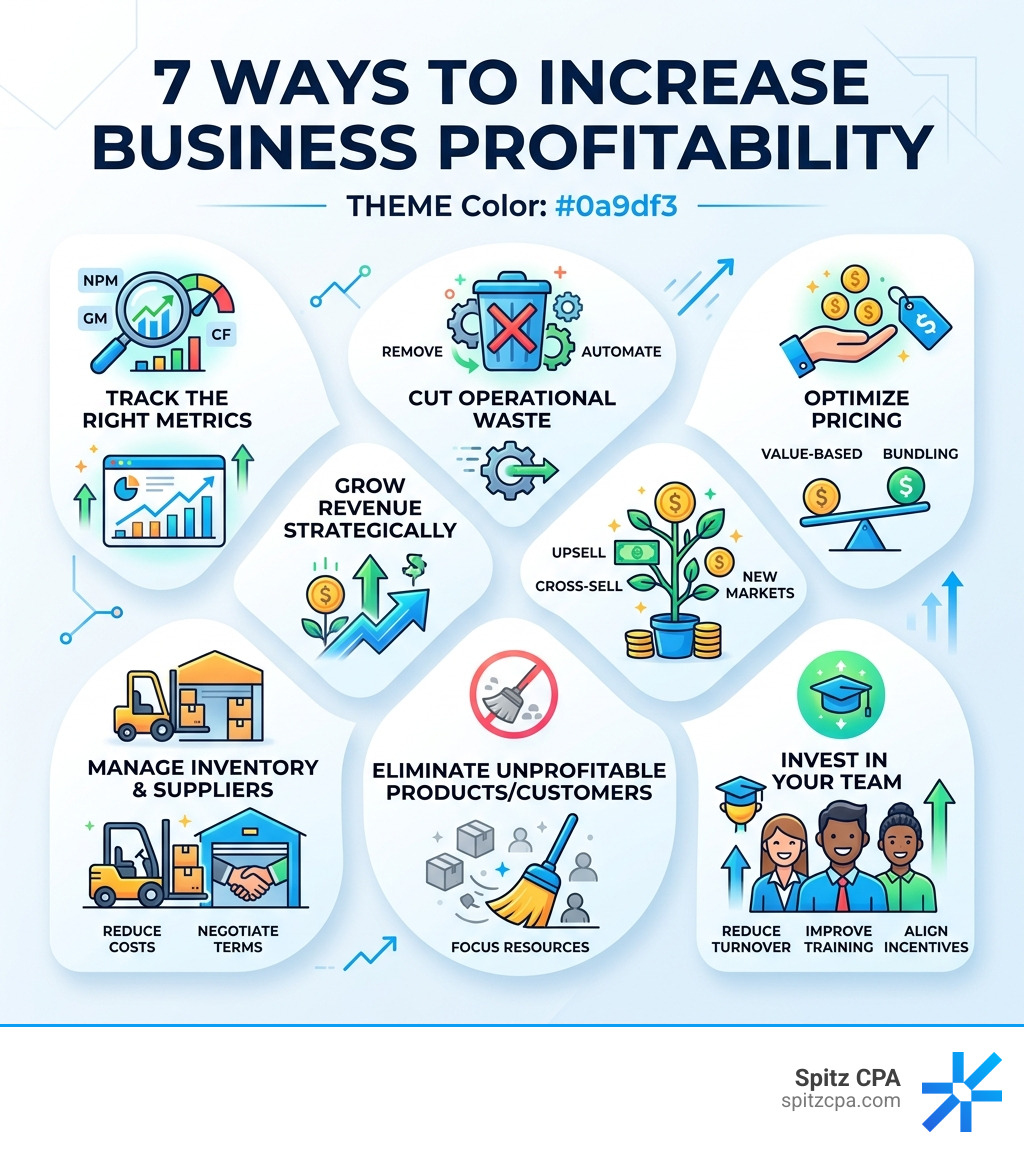
Here are the core ways to increase business profitability:
To increase business profitability, focus on the few moves that have the biggest financial impact. Track core metrics like net profit margin, gross margin, and cash flow so you can see what is working and what is hurting results. Remove operational waste by simplifying processes and automating repetitive tasks where it makes sense. Improve pricing with a value-based approach, look for strategic revenue growth through upselling, cross-selling, and market expansion, and keep inventory and supplier costs under control. Just as important, stop pouring resources into unprofitable products or customers and invest in your team through better training, lower turnover, and incentives tied to profit goals.
Most business owners focus on just one or two of these. The ones who pull ahead work all seven levers together.
Profitability isn’t just about making money — it’s about making more than you spend, consistently and efficiently. A business can have strong revenue and still be losing ground if margins are thin or costs are creeping up unnoticed.
The stakes are real. Nearly 40% of small businesses have less than one month of cash on hand. Without a deliberate focus on profit margins, even a growing business can find itself in trouble fast.
This guide breaks down the most effective, proven strategies to improve your margins — whether you’re running a lean operation or managing a multi-million dollar company.
I’m Michael J. Spitz, a CPA with 15+ years of corporate accounting experience helping businesses across industries master how to increase business profitability through financial modeling, cost accounting, and strategic planning. With a background spanning software, health services, property management, and more, I’ve seen which levers move the needle — and which ones just create busywork. Let’s get into what actually works.
Measuring Success: How to Increase Business Profitability Through Data
If you can’t measure it, you can’t manage it. Many CEOs treat their bank balance as the ultimate indicator of success, but cash in the bank is a lagging indicator. To understand how to increase business profitability, we must look at the efficiency of the “machine” itself.
At Michael J. Spitz, CPA, we often see businesses that are “growing broke.” They are doing more work than ever, but their bank accounts aren’t reflecting that effort. This usually happens because they aren’t tracking three critical metrics:
- Net Profit Margin: This is the percentage of revenue left after every single expense — including taxes and interest — is paid. It tells you how much of every dollar you actually get to keep.
- Gross Margin: This measures the profitability of your products or services before overhead. If your gross margin is low, no amount of marketing will save you; you’re simply not charging enough or your direct costs are too high.
- RNOA (Return on Net Operating Assets): This is a favorite of ours. While EBITDA is a blunt instrument, RNOA shows how efficiently you are using your assets (like equipment or inventory) to generate profit.
According to 12 Tips to Maximise Profits in Business, maintaining an accurate understanding of unit margins for every single product in your catalog is the foundation of a healthy business. For more specialized guidance, you can explore more info about improving business profitability to see how these metrics apply to your specific industry.
Tracking Key Metrics for Long-Term Growth
To achieve sustainable growth, you need to move beyond the P&L (Profit and Loss) statement and look at your balance sheet and cash flow statement. Profit is an accounting concept; cash is a reality.
We recommend tracking a few essential financial ratios every month. The Current Ratio shows whether you can cover short-term obligations by comparing current assets to current liabilities. Days Sales Outstanding (DSO) tells you how long it takes to collect cash after a sale, and a high DSO can quietly drag down profits. The Operating Expense Ratio helps you see whether fixed costs are rising faster than revenue.
By “war gaming” your numbers with integrated financial statements, you can prepare for downside scenarios and ensure you have enough liquidity to weather Arizona’s seasonal economic shifts.
Analyzing Product and Customer Profitability
Not all revenue is created equal. In fact, some revenue actively destroys profit. This is the 80/20 rule in action: typically, 20% of your customers generate 80% of your profit, while the bottom 20% of customers might actually be costing you money to serve.
We encourage our clients to perform a segment analysis. Ask yourself:
- Which products have the highest ROI?
- Which customers demand the most “hand-holding” but pay the least?
- What is the Customer Lifetime Value (CLV) compared to the cost of acquisition?
Eliminating unprofitable activities can be more effective than simply trying to sell more of everything. If you want to dive deeper into this, check out more info about increasing business value.
Operational Efficiency and Waste Elimination
Efficiency is the art of doing more with less. In lean operations, we look for the “Nine Wastes,” which include things like overproduction, waiting times, and unnecessary movement.
Streamlining operations by eliminating non-essential processes can achieve a 20-30% increase in efficiency. This isn’t about working harder; it’s about removing the friction that slows your team down. For a comprehensive look at these levers, read more info about increasing business profitability.
Leveraging Automation to Increase Business Profitability
One of the most dramatic ways to boost your bottom line is through technology. Implementing automation in place of manual processes can offer an ROI of 30-200% within the first year.
Consider these high-impact areas:
- POS Systems: Modern Point of Sale systems do more than take payments; they integrate CRM, analytics, and inventory management.
- Workflow Redesign: If a task is repetitive and manual, it’s a candidate for automation.
- Error Rate Ratio: Aim for an error rate below 1%. High error rates lead to “triple-shipping” costs (shipping the wrong item, paying for the return, and shipping the replacement).
As noted in 30 Simple Ways to Increase Your Profits, redesigning workflows to eliminate non-value-adding tasks is often the “low-hanging fruit” of profitability.
Optimizing Inventory and Supply Chain Management
Inventory is just cash sitting on a shelf, and it carries a cost. Between storage, insurance, and the risk of obsolescence, carrying costs can eat your margins alive.
Just-in-time inventory practices can reduce carrying costs by bringing materials in closer to when they are actually needed, which helps free up cash and limit waste. Supplier negotiation matters too. Instead of accepting the first offer, look for better pricing, volume discounts, or more favorable payment terms. Merchant fees are another often-missed profit lever. Even a small reduction of 0.25% to 0.5% in processing costs can have an outsized impact on profit, sometimes equal to the gain from a large increase in sales volume.
Strategic Revenue Growth and Pricing Models
Increasing prices is often the fastest way to address how to increase business profitability, yet it’s the lever CEOs are most afraid to pull. If you haven’t reviewed your pricing in over a year, you are likely leaving money on the table.
Market Research and Customer-Focused Tactics
Research shows that 70% of consumers are willing to pay more for improved quality or service. If you provide a superior experience, your price should reflect that. Companies that conduct market research are 70% more likely to succeed in launching new products because they understand the customer’s “willingness to pay.”
Instead of “cost-plus” pricing (adding a margin to your costs), try value-based pricing. This focuses on the outcome you provide the customer. If your service saves a client $100,000, charging $10,000 is a bargain, regardless of how many hours it took you to perform the task.
Pricing Strategies to Increase Business Profitability
To maximize revenue without losing customers, consider these models:
- Mixed Bundling: Offer products both individually and as a package. Pure bundling (only offering the package) can actually reduce sales by 20%, but mixed bundling increases the average transaction value.
- Upselling and Cross-selling: Train your team to suggest complementary products. Think of it as the “Amazon approach” — “Frequently bought together.”
- Recurring Revenue: Transitioning to a subscription or maintenance model creates predictable cash flow and significantly increases your business’s valuation multiple.
Empowering Your Team for Maximum ROI
Your employees are your greatest asset, but they can also be a major source of waste if they aren’t engaged. The employee engagement rate in the US is currently around 38%, which means a large portion of the workforce is just going through the motions.
Reducing Turnover and Recruitment Costs
The cost of replacing an employee can range from 0.5x to 2x their annual salary. When you factor in recruitment, onboarding, and the loss of institutional knowledge, turnover is a massive drain on profitability.
40% of employees who receive poor training leave their jobs within the first year. By contrast, investing in training and cross-training makes your team more flexible and productive.
Employee-Driven Profit Ideas:
- Incentive Alignment: Create profit-sharing schemes that reward staff when the company hits specific margin targets.
- Waste Identification: Your front-line staff usually knows where the inefficiencies are. Ask them.
- Safety Training: Reducing workplace injuries directly lowers insurance premiums and lost-time costs.
Frequently Asked Questions about Business Profitability
What is the difference between profit and profitability?
Profit is an absolute dollar amount (Revenue – Expenses). Profitability is a measurement of efficiency. For example, two companies might both make $1 million in profit. But if Company A did it on $5 million in sales and Company B did it on $20 million in sales, Company A is much more profitable. It is a better “machine” for generating returns.
How can small businesses increase profits with limited resources?
Focus on high-ROI activities. You don’t need a massive budget to negotiate with your current suppliers or to implement a “mixed bundling” strategy. Automation tools for bookkeeping and invoicing are now affordable for even the smallest businesses and can save dozens of hours of manual labor every month.
What are the most common pitfalls in profitability improvement?
The biggest mistake is “cutting muscle instead of fat.” This happens when a CEO does across-the-board layoffs that damage the company’s ability to serve customers. Another pitfall is ignoring the data — making decisions based on “gut feeling” rather than analyzing which products and customers are actually driving your margins.
Conclusion
Mastering how to increase business profitability is a journey, not a one-time event. It requires a shift from viewing your business as a series of tasks to viewing it as a compounding system of operations, pricing, and capital efficiency.
At Michael J. Spitz, CPA, we specialize in helping business owners in Gilbert, AZ, and throughout Arizona gain the financial clarity they need to scale with confidence. Whether it’s through accounting clean-up or strategic financial advisory, our goal is to help you achieve that 10x value increase.
If you’re ready to stop guessing and start growing, we’re here to help. For more details on how we can help your bottom line, see more info about profitability services in Gilbert AZ.
Ready to take the next step? Click here for professional accounting and advisory services and let’s build a more profitable future for your business together.
— Michael J. Spitz


