


Why Your Business Needs More Than Basic Bookkeeping
Comprehensive accounting solutions go beyond traditional bookkeeping to provide integrated financial management, strategic tax planning, and data-driven advisory services that help businesses grow profitably and make informed decisions.
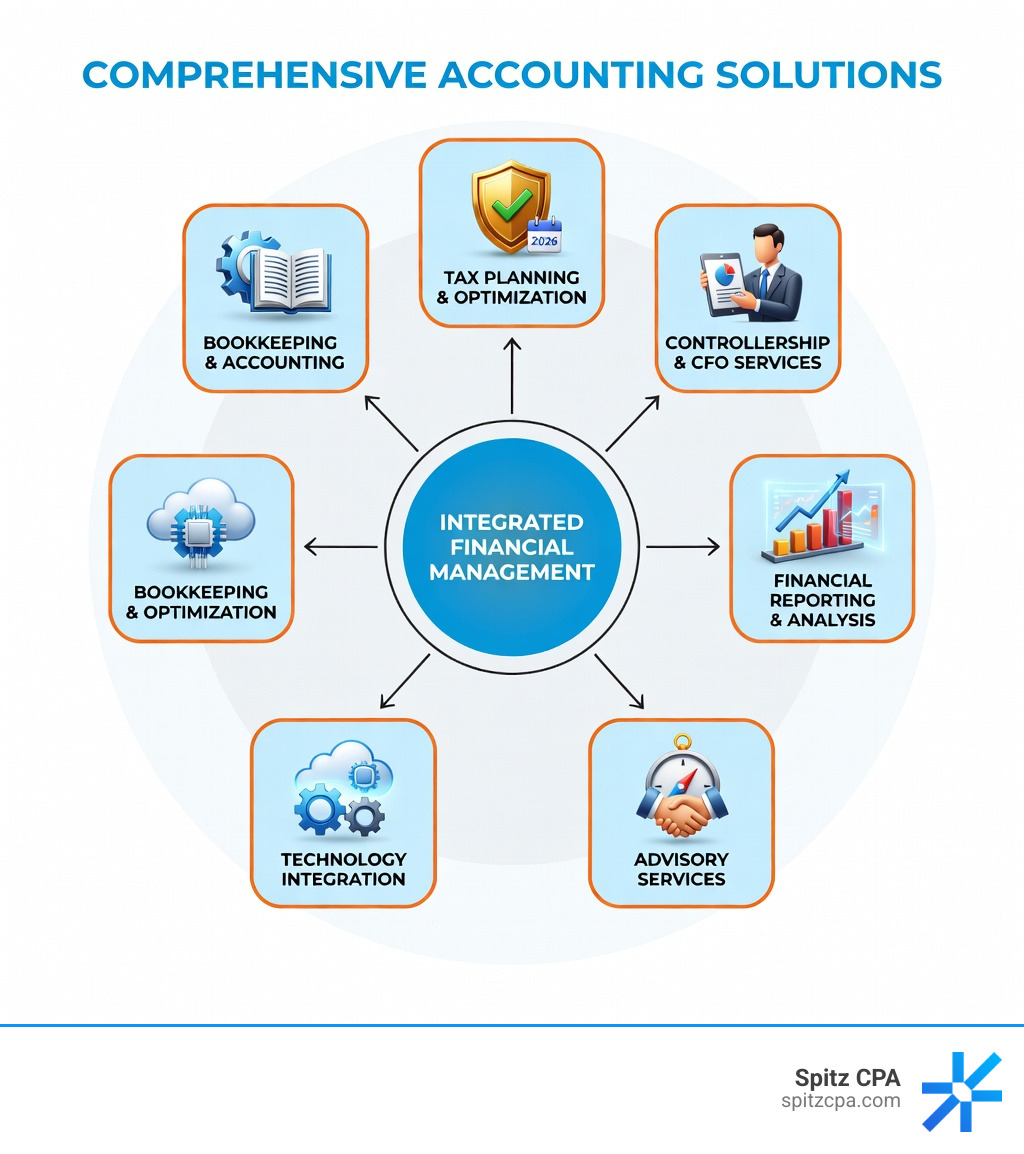
What comprehensive accounting solutions include:
- Bookkeeping and accounting – Transaction recording, categorization, and reconciliation
- Tax planning and optimization – Year-round strategies to minimize liability and ensure compliance
- Financial reporting and analysis – Real-time dashboards, profit and loss statements, and performance monitoring
- Advisory services – Strategic guidance on cash flow, budgeting, and business growth
- Technology integration – Cloud ERP platforms, automation tools, and AI-powered transaction processing
- Controllership and CFO services – Month-end close processes, financial summaries, and executive-level insights
If you’re struggling with antiquated systems that can’t keep up with your growth, you’re not alone. Many business owners find themselves buried in manual processes, lacking confidence in their financial data, and missing opportunities for tax savings. The right comprehensive solution transforms your accounting from a cost center into a profit-driving engine.
Modern technology has changed what’s possible. Cloud platforms like QuickBooks, NetSuite, and Acumatica now offer automation that cuts month-end close times in half. AI agents can categorize transactions, flag anomalies, and provide financial summaries without manual intervention. These integrated approaches allow for the completion of complex SOC reports and specialized industry reporting at scale, ensuring that even high-volume businesses remain audit-ready.
I’m Michael J. Spitz, and with over 15 years of corporate accounting experience spanning software, telecom, property management, and more, I’ve helped businesses implement comprehensive accounting solutions that support strategic growth and financial clarity. My approach combines hands-on technical expertise with the advisory insight business owners need to scale successfully.
Comprehensive accounting solutions word list:
What Are Comprehensive Accounting Solutions?
When we talk about comprehensive accounting solutions, we are looking at the big picture. In the past, traditional accounting was often “reactive.” You would hand a box of receipts to an accountant at the end of the year, and they would tell you how much you owed the government.
Today, a comprehensive approach is “proactive.” It integrates your entire back-office, from the moment a sale is made to the moment you file your taxes. It’s about creating a seamless flow of data that allows for real-time financial analysis. Think of it as having a dedicated finance team that doesn’t just record history but helps you write your business’s future. For those just starting to scale, our Accounting for Entrepreneurs Complete Guide provides a deep dive into how these systems build a foundation for success.
Traditional Accounting Services vs. Comprehensive Solutions
| Feature | Traditional Accounting | Comprehensive Accounting Solutions |
|---|---|---|
| Focus | Historical recording & compliance | Strategic growth & real-time insights |
| Frequency | Monthly or Annual | Daily or Real-time |
| Technology | Desktop software/Paper | Cloud ERP, AI, & Automation |
| Tax Strategy | Once a year (Tax Season) | Year-round optimization |
| Advisory | Rare or reactive | Proactive (Fractional CFO) |
| Data Accuracy | Manual entry (High error risk) | Automated imports & AI review |
Strategic Benefits of Comprehensive Accounting Solutions
One of the most significant advantages of this model is the shift from simple math to strategic guidance. By utilizing Services Accounting, businesses can tap into “Fractional CFO” expertise. This means you get the brainpower of a high-level financial executive without the $200k+ annual salary.
We focus on capital growth and cash flow optimization. Are you sitting on too much inventory? Is your debt-to-equity ratio scaring off investors? A comprehensive provider doesn’t just tell you the numbers; they tell you what the numbers mean. This proactive advisory ensures that you aren’t just surviving the month—you are positioning your business for a 10x value increase.
Industry-Specific Applications for Growth
Accounting isn’t one-size-fits-all. A restaurant in Gilbert, AZ, has very different needs than a local medical practice or a real estate developer.
- Hospitality & Restaurants: Managing thin margins requires precise Services Bookkeeping. With high-volume transactions, you need systems that can handle daily sales polls and labor cost tracking.
- Healthcare: Compliance is king. Whether it’s dental transitions or private equity-backed medical groups, the accounting must be audit-ready and SOC-compliant.
- Real Estate: We look for specialized tax strategies like cost segregation and 1031 exchanges to protect your assets.
- Nonprofits: You need to demonstrate impact. Comprehensive solutions provide the transparency required to satisfy donors and grant-makers while ensuring every dollar is used efficiently.
Core Services Within a Comprehensive Framework
To truly “account for anything,” your financial framework must be robust. At Spitz CPA, we believe that Small Business Accounting should be as sophisticated as enterprise-level finance, but custom for the agility of a smaller firm.
Tax Optimization and Compliance
Tax season shouldn’t be a surprise. With CPA Services for Businesses, we implement year-round tax strategies. This includes expert FICA tax-saving strategies and ensuring you are maximizing every available credit, such as R&D tax credits. By staying ahead of shifting compliance requirements, we turn your tax burden into a managed expense rather than a budget-breaking shock.
Risk Management and Audit Assurance
Growth brings risk. As you scale, you may need SOC reports or specialized audits to satisfy investors or partners. A comprehensive provider ensures that your internal controls are rock-solid. We don’t just “keep the books”—we build a fortress around your financial data to prevent fraud and ensure regulatory compliance.
How AI and Automation Power Comprehensive Accounting Solutions
The “magic” behind modern accounting is automation. We often start with Accounting Clean Up Services to fix past errors, but the goal is to implement systems that prevent errors from happening again.
AI agents, like those found in advanced QuickBooks setups, can now:
- Categorize Transactions: The AI learns your business patterns. If you buy supplies from the same vendor every month, it knows exactly where that goes on the P&L.
- Anomaly Detection: If a utility bill is 300% higher than usual, the system flags it immediately for review.
- Real-Time Reporting: You no longer have to wait 15 days after the month ends to see your profit. You can see it on your phone while having lunch.
Streamlining the Month-End Close Process
The “month-end close” used to be a week of stress for controllers. With NetSuite Solutions for the Controller, this process is transformed. By using automated bank feeds and Plooto or Dext for expense management, reconciliations happen almost instantly.
Imagine being able to wrap up your month-end responsibilities from home after the kids are in bed, with 100% confidence in your data. That is the “peace of mind” that comprehensive solutions provide.
Leveraging Modern Technology for Financial Excellence
The backbone of any modern accounting firm is its technology stack. We are no longer tethered to a single office or a single computer.
The Power of Cloud ERP
Platforms like Acumatica and Sage Intacct represent the future of business management. These aren’t just “accounting software”—they are Cloud ERP Platforms that connect your inventory, sales, and HR into one source of truth.
- Low-Code Customization: You can tailor workflows and dashboards to fit your specific needs without being a computer programmer.
- Scalability: Whether you have 3 employees or 300, the system grows with you, reducing the need for massive capital investments in IT.
- Data Security: With multi-layered encryption and role-based access, your financial data is often safer in the cloud than on a physical server in your office.
Enhancing Comprehensive Accounting Solutions with Integrated Platforms
The goal is a “connected” business. By using APIs, your accounting system can talk to your CRM (like Salesforce) or your eCommerce store (like Shopify). This eliminates manual data entry, which is the #1 cause of accounting errors. When your data is centralized, you gain a 360-degree view of your business, which we detail in our Category Accounting resources.
Key Considerations When Choosing a Provider
Choosing an accounting partner is one of the most important decisions you will make. In Gilbert, AZ, and the surrounding Arizona area, you want someone who understands the local business climate but has the technical “chops” of a national firm.
- Experience Levels: Look for a team with a mix of public accounting and corporate experience. Michael J. Spitz brings over 15 years of diverse industry knowledge to the table.
- Technology Stack: Do they use modern tools like QuickBooks Online, Fathom, and AI-driven automation? If they are still using paper ledgers, they are holding you back.
- Pricing Models: Transparent, value-based pricing is usually better than hourly billing. You want a partner who is incentivized to be efficient, not one who gets paid more the longer they take.
- Scalability: Can they handle your business when you double in size? Ask about their experience with multi-entity setups and Fractional CFO services.
- Personalized Guidance: You aren’t just a number. You need a provider who will pick up the phone and walk you through a complex financial decision.
Frequently Asked Questions about Business Accounting
How do comprehensive solutions differ from basic bookkeeping?
Basic bookkeeping is just data entry—recording what happened in the past. Comprehensive accounting solutions include tax planning, high-level advisory, technology integration, and strategic financial analysis to help you grow.
Can these services help with year-round tax optimization?
Yes! Instead of waiting until April, we look at your financials every month to implement FICA tax-saving strategies, R&D credits, and asset management plans that lower your overall tax burden.
What role does AI play in modern accounting accuracy?
AI automates the “boring” stuff, like categorizing thousands of transactions and reconciling bank statements. This reduces human error and allows your CPA to focus on high-level strategy instead of data entry.
Conclusion
At the end of the day, your accounting should be an asset, not a chore. By moving toward comprehensive accounting solutions, you gain the financial clarity needed to scale your business with confidence. Whether you are dealing with a messy set of books that needs a major clean-up or you are looking for a strategic partner to help you reach that 10x value goal, the right support makes all the difference.
Michael J. Spitz and the team at Spitz CPA are dedicated to helping Arizona business owners transform their finances. We don’t just count the beans; we help you grow the garden.
Discover how Michael J. Spitz provides comprehensive accounting solutions to scale your business


