


Financial Planning Creates a Clearer Path to Your Goals
Financial planning is the process of understanding where your money stands today, deciding what you want it to accomplish, and building a practical path between the two. Start by calculating net worth, tracking cash flow, setting time-based goals, protecting against major risks, and directing available savings toward debt reduction, emergency reserves, investments, and tax-efficient accounts.
For business owners and entrepreneurs, this work connects personal security with business decisions. A reliable plan can clarify how much cash you need on hand, what debt deserves priority, how taxes may affect your choices, and whether your current savings and investments support the future you want. It is not a one-time document; it should change as your income, business, family, tax position, and goals change.
I am Michael J. Spitz, with more than 15 years of corporate accounting experience spanning financial modeling, budgeting, cash management, fundraising diligence, tax preparation, and strategic decision-making. In the sections ahead, I will explain financial planning basics in plain language so you can build a more informed, adaptable financial roadmap.
Core Pillars of a Comprehensive Financial Planning Framework
Building sustainable financial stability requires an interconnected strategy rather than treating your finances as isolated decisions. A truly comprehensive framework bridges daily operational cash needs with multi-decade objectives, ensuring every dollar earned contributes to wealth protection, retirement readiness, and eventual wealth transfer. By looking at your total financial picture simultaneously, you prevent situations where aggressive growth strategies leave you vulnerable to unexpected emergencies or tax penalties.
The financial landscape is evolving rapidly, which makes professional guidance more relevant than ever. Demand for personal financial advisors is expected to grow by 13% through 2032 according to the U.S. Bureau of Labor Statistics, driven largely by an aging population and an unprecedented $30 trillion intergenerational wealth transfer passing from baby boomers to their heirs. Many individuals and business owners across Arizona turn to professional communities such as the FPA Arizona financial planning association to locate holistic guidance that integrates retirement, estate, tax, and insurance planning into a single coordinated effort.
The Foundations of Lifelong Financial Planning
Lifelong financial planning begins by establishing clear goal horizons that match your life stage. Goals generally fall across three distinct timelines: short-term targets spanning six months to five years, mid-term milestones covering five to ten years, and long-term vision looking beyond a decade. Establishing these timelines allows you to balance liquidity against investment risk, ensuring money needed for a near-term real estate purchase is not exposed to volatile market swings while your retirement accounts compound over decades.
A crucial part of goal setting is distinguishing between essential needs and discretionary wants. Categorizing your financial objectives provides the flexibility required to navigate changing economic conditions without abandoning long-term growth. When you align your capital allocation with your core values, you create a sustainable foundation, transitioning smoothly from seed to success crafting your financial growth strategy whether you are managing household earnings or reinvesting capital into a expanding company.
Essential Steps to Establish Your Roadmap
Developing an actionable financial roadmap follows a structured, step-by-step sequence. It begins with comprehensive asset audits, where you catalog liquid accounts, business equity, real estate, and retirement holdings. Next, you audit existing liabilities to eliminate high-cost debt balances, establish foundational cash reserves, and implement appropriate risk protections before deploying excess capital into long-term wealth accumulation strategies.
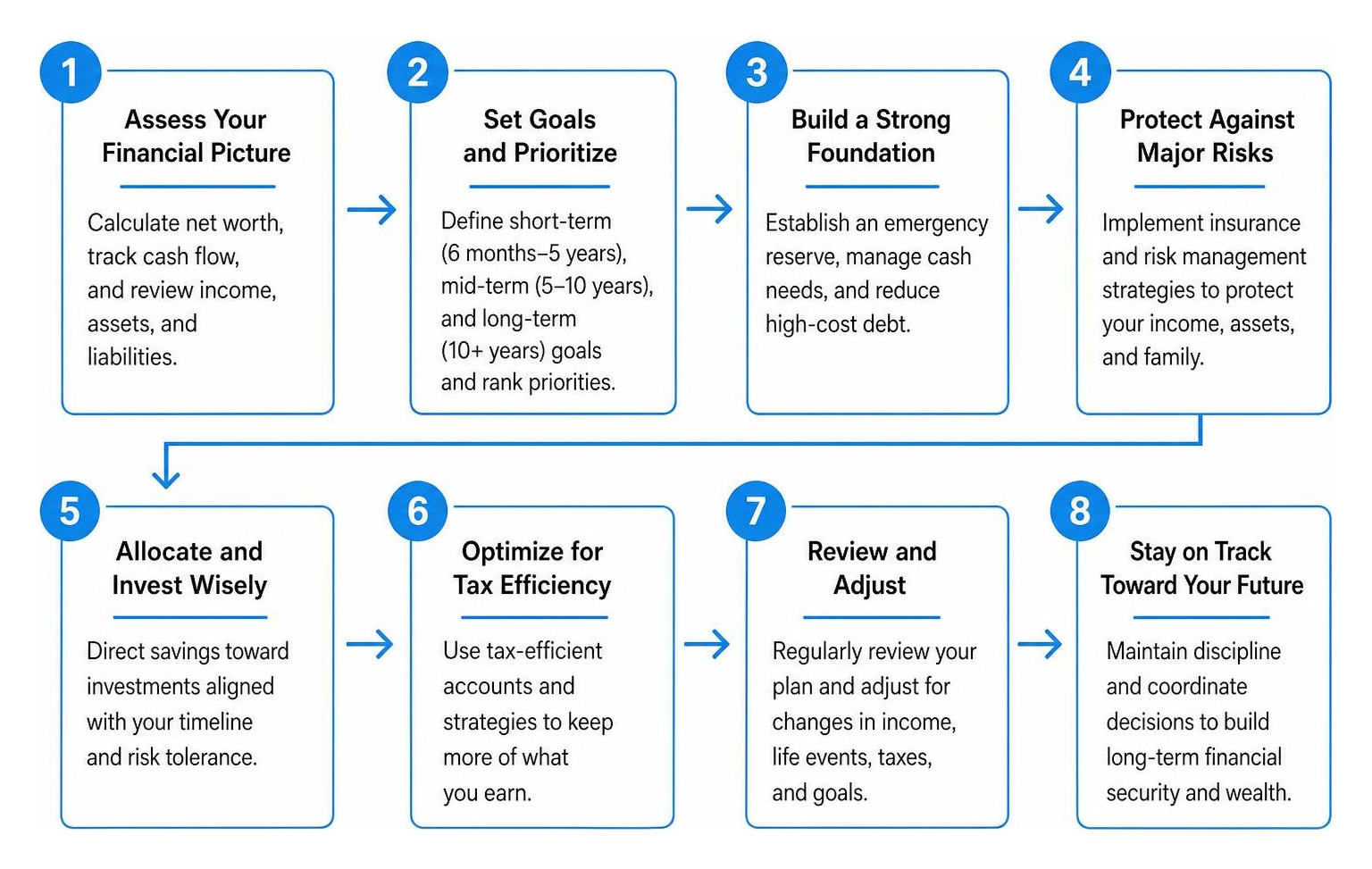
Short-term objectives, such as building emergency reserves or funding a major family expense within one to three years, require high capital preservation and absolute liquidity in stable cash equivalents. Mid-term targets, like funding higher education or buying commercial property within four to nine years, benefit from balanced growth models that combine conservative equities and fixed income. Long-term goals spanning ten or more years, primarily retirement and generational wealth transfer, leverage diversified equity portfolios and compound interest to outpace inflation and maximize terminal portfolio value.
Assessing Cash Flow, Net Worth, and Budgeting Mechanics

Gaining complete financial clarity starts with calculating your personal net worth, which serves as a balance sheet of your economic health. The formula is straightforward: subtract your total liabilities from your total assets. Assets include liquid cash, taxable investment portfolios, retirement balances, real estate equity, and privately held business valuations. Liabilities encompass mortgages, personal loans, business obligations, and revolving consumer debt. Regularly updating this calculation gives you an objective metric to measure progress over time.
Alongside your balance sheet, you must establish transparent cash flow management to understand how income moves through your household or business each month. An expenditure audit requires compiling bank, payroll, and credit card statements across an entire twelve-month period and dividing the totals by twelve. This reveals seasonal variances, unmonitored recurring subscriptions, and hidden cash leakages that often skew standard monthly budgeting estimates.
Budgeting Frameworks and Liquidity Control
Maintaining healthy liquidity requires an intentional budgeting framework that ensures saving happens before discretionary spending occurs. A practical structure to implement is the 60/30/10+15 rule. Under this framework, you allocate fifteen percent of your pre-tax income directly to retirement savings. From your remaining net take-home pay, allocate sixty percent or less toward essential living costs such as housing, healthcare, and utilities, thirty percent to discretionary lifestyle choices, and ten percent to short-term savings targets.
Automating transfers to designated accounts ensures you adhere to your savings targets without relying on willpower alone. When comparing daily spending against future projections, understanding budgeting vs forecasting whats the difference and why it matters helps distinguish between controlling your routine operational overhead and modeling your future financial outcomes under varying income conditions.
Managing and Eliminating Liabilities
Liability reduction must be approached with strategic discipline, as debt costs severely erode long-term compounding. The average American household carries over $104,000 in debt across mortgages, auto financing, and consumer loans. Credit cards frequently carry interest rates between 14% and 25% or higher, turning unpaid balances into severe wealth drains that demand immediate elimination before expanding speculative investments.
Two proven approaches exist for debt elimination: the debt avalanche and the debt snowball methods. The avalanche method prioritizes debts with the highest interest rates, mathematically minimizing the total interest paid over time. The snowball method focuses on paying off the smallest balances first to generate psychological momentum and free up cash flow quickly. For high-interest credit lines and any loan carrying an interest rate higher than 6%, aggressive repayment yields a guaranteed, risk-free financial return.
Fortifying Wealth with Emergency Reserves and Asset Protection

No financial strategy is secure without adequate protection against unexpected life disruptions. Establishing an emergency reserve of three to six months of essential living expenses provides an indispensable safety cushion. These funds should be stored in liquid, FDIC-insured high-yield accounts or institutional money market instruments, remaining entirely isolated from market volatility.
Currently, just over half of all adults have three months of emergency savings set aside, leaving many households vulnerable to sudden medical events or economic downturns. An emergency reserve prevents you from being forced to liquidate long-term investments during market contractions or taking on high-interest loans when unexpected expenses occur.
Risk Mitigation Through Comprehensive Insurance
Comprehensive risk mitigation acts as a financial shield for your accumulated assets and future earning potential. Disability coverage is an essential component that is frequently overlooked, even though statistics show a disabling condition will push one in four of today’s 20-year-olds out of work for at least a year before retirement. Structuring policies with suitable elimination periods—the waiting duration between disability onset and benefit payout—ensures you maintain cash flow during recovery without paying excessive premiums.
Your insurance structure should also incorporate adequate health coverage, property and casualty policies, commercial liability protection, and term life insurance. Life insurance protects dependents against lost earning capacity, while umbrella liability coverage creates an essential barrier safeguarding your real estate, investment accounts, and personal wealth from catastrophic legal claims.
Estate Planning Essentials for Generational Security
Estate planning ensures your wealth is distributed according to your intentions while minimizing probate costs and administrative delays. Foundational documents include a legally valid will, durable power of attorney for financial matters, advance healthcare directives, and healthcare proxies. These legal tools define who will manage your affairs if you become incapacitated and prevent complex court interventions.
Maintaining up-to-date beneficiary designations on retirement accounts, annuities, and life insurance policies is equally critical, as these designations legally override instructions outlined in a traditional will. For business owners, conducting an annual business financial health check allows you to align corporate operating agreements, buy-sell contracts, and ownership transfer mechanisms with your personal estate plan, ensuring uninterrupted business continuity during intergenerational wealth transfers.
Strategic Investing and Tax-Advantaged Growth Strategies
Building long-term wealth requires putting your surplus cash flow to work through diversified investment strategies. Asset allocation—the balance between equities, fixed income, real estate, and cash—serves as the primary driver of portfolio performance and volatility management. Diversifying across broad market sectors, international regions, and asset classes helps mitigate individual company risk while positioning your capital to capture global economic growth.
Maintaining an investment strategy also demands managing behavioral impulses during periods of market volatility. Research consistently shows that attempts to time market cycles generally lead to lower returns compared to disciplined dollar-cost averaging and long-term holding. Rebalancing your portfolio once or twice a year restores your target asset allocation, systematically trimming outperforming asset classes to purchase undervalued sectors without emotional interference.
Aligning Investment Strategies with Financial Planning Objectives
Every investment allocation must align directly with the timeline and purpose of the specific goal it supports. Long-term compounding serves as the engine for wealth accumulation, allowing reinvested earnings, dividends, and capital gains to multiply substantially over multi-decade horizons. Aligning your asset management with clear milestones ensures you take appropriate risk during your accumulation years while gradually shifting toward capital preservation as you approach retirement.
For business founders and executives, your enterprise often represents your largest single financial asset. Structuring corporate cash flows and optimizing internal business investments directly translates into higher business valuation. By discovering how to increase business value through strategic reinvestment and operational improvements, you strengthen both your corporate balance sheet and your personal investment portfolio.
Maximizing Tax-Advantaged Accounts and Deductions
Optimizing your savings through tax-advantaged accounts is one of the most effective ways to accelerate wealth accumulation. In 2026, elective deferral limits allow individuals to contribute up to $24,500 into workplace plans like 401(k)s and 403(b)s. Workers aged 50 and older can contribute an additional $8,000 catch-up contribution, while those between ages 60 and 63 can take advantage of an enhanced catch-up contribution of up to $11,250 under updated SECURE 2.0 provisions. Individual Retirement Account contribution limits for 2026 stand at $7,500, with an extra $1,100 catch-up allowance for savers aged 50 and above.
Health Savings Accounts offer an exceptional wealth-building tool through their triple-tax advantage: contributions are tax-deductible, investment growth is tax-free, and distributions for qualified medical expenses are completely tax-free. Considering that a 65-year-old retiring may need around $172,500 in after-tax savings to cover healthcare costs throughout retirement, maximizing an HSA today provides substantial future utility. Implementing advanced tax planning strategies alongside tax-loss harvesting, asset location management, and charitable giving allows you to keep more of your hard-earned wealth working for your future.
Frequently Asked Questions About Personal Wealth Management
What is the main difference between budgeting and a financial plan?
Budgeting is an operational, short-term exercise focused on tracking income and managing monthly expenses to ensure positive cash flow. In contrast, a financial plan is a strategic, long-term roadmap that integrates budgeting with net worth tracking, risk management, tax reduction, investment management, retirement modeling, and estate planning to achieve comprehensive wealth goals.
How often should an individual review and adjust their financial roadmap?
You should conduct a formal review of your financial roadmap at least once a year to rebalance portfolios, verify beneficiary designations, and review tax strategies. Additionally, significant life events—such as marriage, divorce, the birth of a child, a major career change, business acquisitions, or receiving an inheritance—should trigger an immediate plan review to adapt to your new circumstances.
When should debt payoff be prioritized over retirement investing?
High-interest credit card debt and any personal loan carrying an interest rate of 6% or higher should generally be paid off before investing additional discretionary capital beyond capturing your full employer 401(k) match. Paying off high-interest debt provides a guaranteed, risk-free financial return equivalent to the avoided interest rate, whereas investing extra funds while carrying high-cost liabilities drags down overall net worth growth.
Conclusion
Creating and maintaining a sound financial roadmap provides the structure and confidence necessary to navigate an ever-changing economic landscape. By gaining clarity on your cash flow, managing debt efficiently, protecting against unforeseen risks, and maximizing tax-efficient investment vehicles, you establish a solid foundation for sustainable, multi-generational wealth.
At Spitz CPA, we believe that true wealth preservation requires integrating rigorous accounting fundamentals with comprehensive advisory strategies. As Michael J. Spitz, our goal is to deliver personalized guidance, detailed financial modeling, and proactive tax solutions that help you protect your capital and reach your long-term milestones. Connect with us today to explore our personalized financial services and gain clarity over your financial future.


