


Why Most Businesses Are Leaving Money on the Table
Cost reduction strategies are structured approaches businesses use to cut unnecessary expenses and improve profitability — without sacrificing quality or growth.
Here are the most effective ones at a glance:
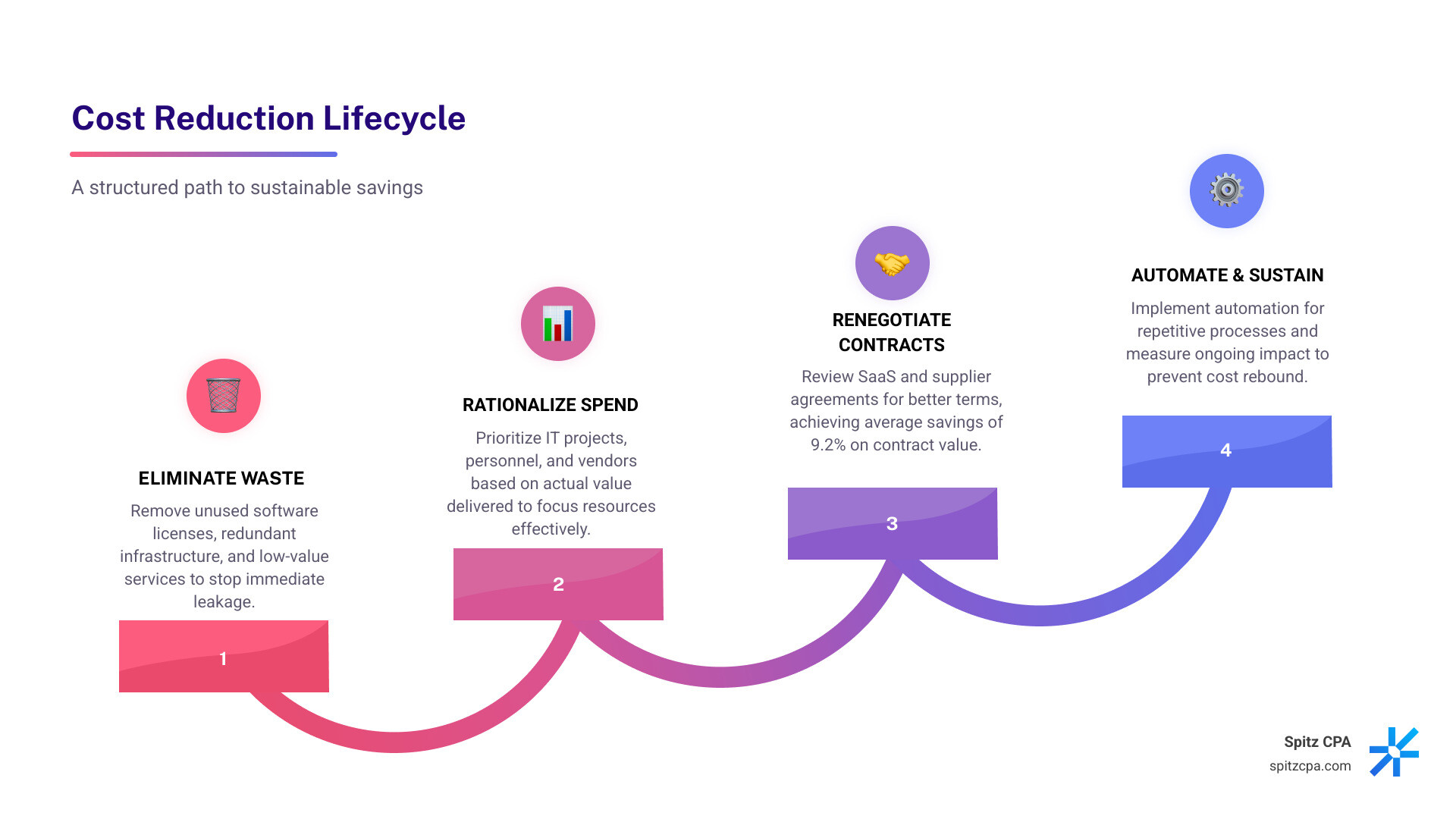
- Eliminate unused software licenses, redundant infrastructure, and low-value services
- Rationalize IT projects, personnel, and vendor relationships based on actual value delivered
- Renegotiate SaaS contracts and supplier agreements — companies save an average of 9.2% on total contract value through effective negotiation
- Automate repetitive processes — accounting automation alone can yield up to 200% ROI in the first year
- Consolidate suppliers and procurement to reduce maverick spending and increase buying power
- Embrace remote work — fully remote employees have been shown to be 24% more productive than their in-office counterparts
- Audit subscriptions and licenses — businesses can save up to 30% by optimizing software configurations and recycling unused licenses
- Foster a cost-conscious culture where employees at every level are engaged in identifying waste
Here’s the hard truth: only about 20% of cost programs actually succeed. BCG research comparing this to a sports team winning just one in every five games puts it in sharp perspective. Most businesses either cut too bluntly — slashing headcount across the board — or they treat cost reduction as a one-time event rather than a structured, ongoing discipline.
The result? Costs rebound. Morale drops. And the same exercise repeats itself every one to two years.
What separates businesses that win at this from those that don’t isn’t willpower — it’s having the right framework.
I’m Michael J. Spitz, CPA, and with over 15 years of corporate accounting experience spanning budgeting, cost accounting, vendor negotiations, and financial modeling across industries from SaaS to health services, I’ve helped businesses implement practical cost reduction strategies that actually stick. In this guide, I’ll walk you through a clear, actionable roadmap — from quick wins to long-term transformation.
Know your cost reduction strategies terms:
Understanding the Framework: Cost Reduction vs. Cost Optimization
Before we dive into the “how,” we need to clarify the “what.” In our work at Spitz CPA, we often see business owners use these terms interchangeably, but they represent two different gears in your financial engine.
Cost reduction is typically a short-term, tactical response to immediate pressure. Think of it as a “one-time” measure to release cash quickly. When economic uncertainty hits or profits dip below expectations, you look for the low-hanging fruit—the unused subscriptions, the overpriced vendors, or the “nice-to-have” projects.
Cost optimization, on the other hand, is a continuous, strategic discipline. It’s about driving value-driven growth. Instead of just cutting, you are reallocating resources from low-value activities to high-value ones that differentiate your business. Efficient growth companies treat spending on core capabilities as a competitive advantage rather than just an expense.
| Feature | Cost Reduction | Cost Optimization |
|---|---|---|
| Focus | Expense elimination | Value maximization |
| Duration | Short-term/One-time | Ongoing/Continuous |
| Goal | Immediate P&L relief | Sustainable margin improvement |
| Approach | Tactical/Reactive | Strategic/Proactive |
Successful leaders learn to balance both. You might use a rapid cost reduction framework to stabilize the ship during a storm, but you use Cost Optimization Done Right to ensure the ship is built to win the race.
High-Impact IT Cost Reduction Strategies
For many businesses in Gilbert, AZ, and beyond, the IT landscape has become a “black box” of mounting expenses. Between “SaaS sprawl” and legacy hardware, it is often the first place we look to find significant savings.
A structured IT cost reduction framework starts with visibility. You cannot manage what you cannot see. We recommend mapping your entire IT landscape to identify overlaps. For instance, is your marketing team using one project management tool while your engineering team uses another? That’s waste.
One of the most powerful moves is application rationalization. This involves evaluating every piece of software in your stack based on its business value and technical fit. By optimizing software configurations, companies can often slash their software spend by 30%.
If managing this complexity feels overwhelming, our fractional CFO services can help you navigate these technical audits without needing a full-time executive on the payroll.
Eliminate, Rationalize, and Renegotiate
To make your cost reduction strategies actionable, we break them down into three pillars:
- Eliminate: Start with the “zombie” licenses. These are subscriptions for employees who left months ago or software that hasn’t been logged into for 90 days. Also, look at end-user computing—do you have unused servers sitting in a data center racking up power and maintenance costs?
- Rationalize: This is about prioritization. Look at your current IT projects. Are they all essential? If a project doesn’t have a clear ROI or align with your 2025 goals, it should be paused or canceled. This also applies to personnel; ensure your high-talent staff are focused on innovation, not maintaining low-value legacy systems.
- Renegotiate: Don’t just accept the auto-renewal. Cloud services and SaaS vendors are often willing to provide discounts for longer commitments or consolidated licensing. Review your contracts at least once a year.
Operational Excellence: Streamlining Procurement and Facilities
Beyond the digital world, your physical operations offer fertile ground for cost reduction strategies. We’ve found that many businesses suffer from “maverick spending”—where different departments buy the same items from different vendors at varying prices.
One of the quickest wins is supplier consolidation. By moving your spend to fewer, high-quality partners, you gain significant leverage. According to World Commerce & Contracting, companies can achieve 9.2% contract savings simply through more effective negotiation.
Inventory is another area where cash gets trapped. Adopting a just-in-time (JIT) inventory system helps you balance stock levels so you aren’t paying to store items that aren’t selling. This directly improves your cash flow management, keeping your capital liquid and ready for opportunities.
Modernizing Procurement with Cost Reduction Strategies
In today’s market, manual procurement is a recipe for high overhead. Implementing e-procurement software provides real-time market intelligence, helping you spot when you’re being charged above-market rates.
Furthermore, accounting automation is a game-changer. It shifts your finance team from data entry to data analysis. Instead of just recording costs, they can help you uncover them.
The shift to remote work is perhaps the most significant operational shift in decades. Consider these benefits:
- Reduced Overhead: Smaller office footprints mean lower rent, utilities, and maintenance.
- Higher Productivity: Studies have shown that remote employees can be 24% more productive than those in an office.
- Talent Retention: Offering flexibility helps you keep your best people, saving you the $4,700 average cost of hiring a new employee.
The Human Element: Cultivating a Cost-Conscious Culture
You can have the best spreadsheets in the world, but if your team isn’t on board, your cost reduction strategies will fail. The employees closest to your daily operations are the ones most likely to spot waste—if they are motivated to look for it.
Getting employee buy-in requires transparency. When we provide accounting for entrepreneurs, we emphasize that cost-cutting shouldn’t feel like a “punishment.” Instead, frame it as a way to protect the company’s future and fund growth.
Continuous training is an investment, not an expense. As automation takes over routine tasks, your staff needs to adapt. For example, a machinist might need to become a programmer. By investing in these skills, you improve efficiency and reduce the need for expensive outside consultants.
Driving Employee-Led Cost Reduction Strategies
How do you turn cost-consciousness into a habit?
- Corporate Rewards: Create a program that rewards employees who identify significant savings. If a team member finds a way to cut utility costs by 15%, share a portion of those savings with them.
- Productivity Focus: Move away from measuring “hours worked” and focus on output. This naturally encourages staff to find leaner, faster ways to get the job done.
- Waste Reduction Initiatives: Use lean principles like the 5S methodology (Sort, Straighten, Shine, Standardize, Sustain) to keep workspaces efficient.
- Shared Ownership: When every department head is responsible for their own budget and “owns” their savings, the culture shifts from “spending what’s left” to “saving what’s possible.”
Measuring Success and Ensuring Sustainability
A common mistake is treating cost reduction as a “sprint.” You cut, you see the bank balance go up, and then you stop paying attention. Sustainable success requires a “marathon” mindset.
To ensure your efforts last, you need a governance framework. We often look to proven models like Gartner’s TIME framework (Tolerate, Invest, Migrate, Eliminate) for applications or ScottMadden’s seven-step process for sustainable change. The key is to build these savings directly back into your future budgets. If you saved $50,000 on vendor contracts this year, your budget for next year should reflect that new baseline.
Our goal is always to help you improve business profitability by making these changes part of your company’s DNA.
Tracking ROI and Long-Term Impact
To know if your cost reduction strategies are working, you must track more than just the bottom line. Watch these metrics:
- Financial Metrics: Gross profit margin, ROI on automation, and cost-to-serve.
- Productivity Benchmarks: Labor output per hour and project cycle times.
- Employee Metrics: Retention rates and engagement scores. If turnover spikes after a cost-cutting drive, you may have cut too deep.
- Customer Satisfaction: Use Net Promoter Scores (NPS) to ensure your efficiency gains aren’t hurting the customer experience.
Frequently Asked Questions about Cost Reduction
What is the difference between cost reduction and cost optimization?
Cost reduction is a tactical, often short-term effort to decrease expenses (e.g., canceling an unused subscription). Cost optimization is a strategic, ongoing process of ensuring every dollar spent is driving the maximum possible value for the business.
How can automation provide a high ROI in the first year?
Accounting automation, for example, can yield up to 200% ROI in year one by drastically reducing manual data entry errors, eliminating late fees through automated bill pay, and freeing up staff to focus on high-impact financial analysis rather than clerical work.
Why do most cost reduction programs fail to meet their targets?
Most fail (about 80%) because they use “blunt-force” cuts like across-the-board headcount reductions. This damages morale and often cuts into the “muscle” of the company rather than the “fat.” Success requires a surgical approach that redesigns the operating model and gains leadership alignment early on.
Conclusion
Implementing effective cost reduction strategies isn’t about being “cheap”—it’s about being disciplined. By eliminating waste, rationalizing your technology, and fostering a culture that values efficiency, you transform your business into a “Lean Machine” capable of weathering any economic storm.
At Spitz CPA, we specialize in helping businesses in Gilbert, AZ, and across Arizona find that financial clarity. Whether you need an accounting clean-up to see where your money is actually going or strategic guidance to 10x your business value, Michael J. Spitz and our team are here to provide the personalized guidance you need for sustainable growth.
Ready to unlock your business’s full potential? Let’s build a more profitable future together.


