


What Are Home Office Tax Deductions (and Do You Qualify)?
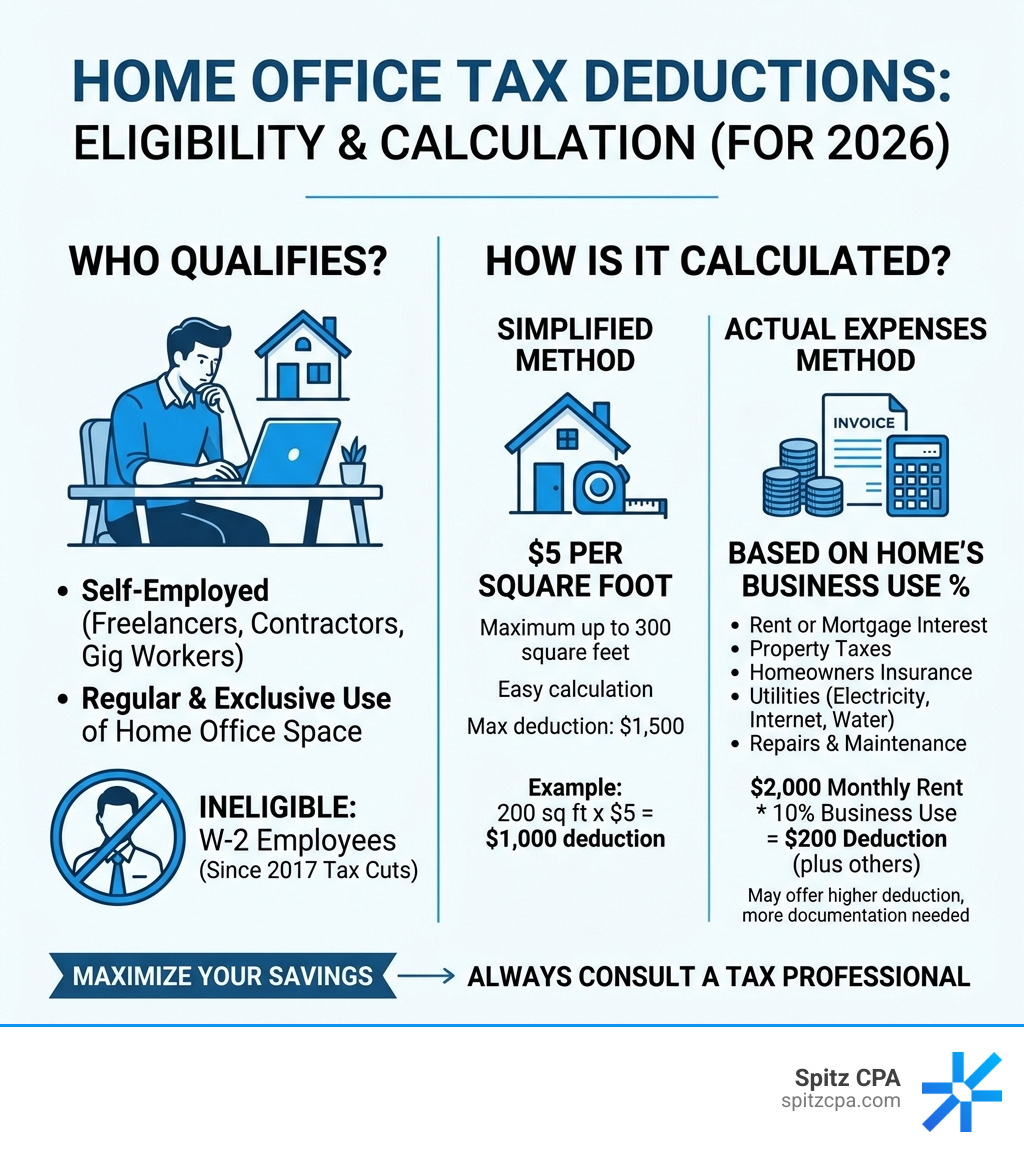
Home office tax deductions let eligible self-employed workers write off a portion of their home expenses — things like rent, utilities, insurance, and mortgage interest — when they use part of their home regularly and exclusively for business.
Here’s the quick answer on who qualifies and how it works:
| Question | Quick Answer | |
|---|---|---|
| Who qualifies? | Self-employed, freelancers, independent contractors, gig workers | |
| W-2 employees? | No — ineligible since the 2017 Tax Cuts and Jobs Act | |
| Key requirement | Space must be used regularly and exclusively for business | |
| Deduction methods | Simplified ($5/sq ft, max $1,500) | or Actual Expenses |
| Where to claim | Schedule C (Form 1040), with Form 8829 for actual expenses |
If you’re a business owner or freelancer working from home, this deduction can meaningfully reduce your tax bill. But the rules have tripped up plenty of people — especially after the Tax Cuts and Jobs Act of 2017 eliminated the deduction for W-2 employees entirely.
This guide walks you through exactly how to calculate your deduction, which method saves you more money, and how to stay audit-proof.
I’m Michael J. Spitz, CPA, and with over 15 years of corporate accounting experience across industries from tech to property management, I’ve helped countless self-employed clients navigate home office tax deductions correctly and confidently. Let’s break it all down in plain language.
Know your home office tax deductions terms:
Who Qualifies for Home Office Tax Deductions?
Navigating home office tax deductions starts with one big question: Are you actually eligible? In the “old days” (pre-2018), many employees could write off their home office expenses if they worked from home for the convenience of their employer. However, the Tax Cuts and Jobs Act (TCJA) changed the game.
As we sit here in April 2026, the rules established by the TCJA are still very much in effect. This means that if you are a W-2 employee who receives a paycheck from a boss, you generally cannot claim the home office deduction on your federal return, even if you work from home 100% of the time.
So, who is invited to the party?
- Self-employed individuals: This includes sole proprietors and partners.
- Independent contractors: If you get a 1099-NEC at the end of the year, you’re likely in.
- Freelancers and Gig Workers: Whether you’re a graphic designer in Gilbert or a consultant traveling across Arizona, your home base counts.
- Side Hustle Owners: Even if you have a W-2 job, if you run a separate business from your home in the evenings or weekends, you can claim the deduction against that specific business income.
According to the Home Office Deduction | Internal Revenue Service, the deduction is available to both homeowners and renters. It doesn’t matter if you live in a house, an apartment, a condo, or even a houseboat — as long as it meets the IRS definition of a “home.”
The “Regular and Exclusive Use” Rule
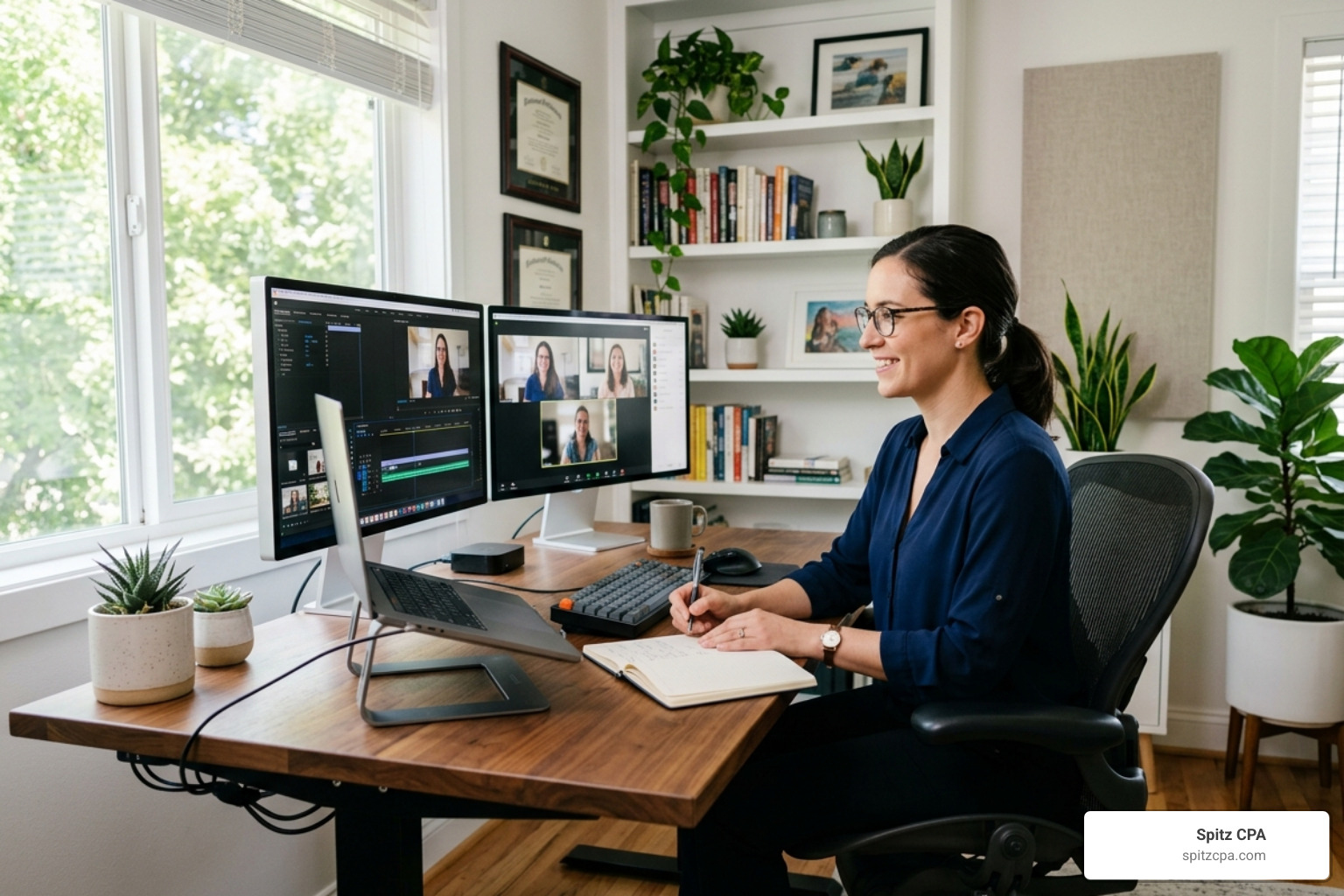
This is where the IRS gets strict. To qualify for home office tax deductions, your space must pass the “exclusive use” test. This means you must use a specific area of your home only for your trade or business.
If you use your dining room table to write code during the day but eat dinner there at night, that space does not qualify. The IRS wants to see a dedicated space. It doesn’t have to be a whole room with a door (though that helps); it just needs to be a separately identifiable space used solely for work.
- The “Mother-in-Law” Test: If your mother visits once a year and sleeps in your office on a pull-out couch, you have technically violated the “exclusive use” rule.
- The “Homework” Test: If your kids use your office computer to do their school projects, that’s no longer an exclusive business space.
However, there are some cool spots that do qualify if used exclusively:
- A spare bedroom turned into a studio.
- A detached garage or workshop.
- A studio, barn, or greenhouse on your property.
We always tell our clients to Maximize Tax Deductions by ensuring their workspace is clearly defined. If an auditor walks in, they should see an office, not a playroom with a desk in the corner.
Defining Your Principal Place of Business
To claim home office tax deductions, your home must generally be your “principal place of business.” This doesn’t mean you have to spend every waking second there. It means it’s the primary location where you conduct the most important parts of your business or where you handle administrative tasks.
Since a landmark rule change in the late 90s, the IRS has made it easier for people who work “in the field” to qualify. For example:
- The Plumber: You spend all day at job sites in Gilbert, but you come home to your office to do your billing, bookkeeping, and scheduling. Since you have no other fixed location to do these “administrative or management activities,” your home office qualifies as your principal place of business.
- The Consultant: You meet clients at their offices, but you prepare all your reports and conduct all your research from your home desk.
If you have a separate unattached structure (like a studio or a shed) that you use exclusively for business, it doesn’t even have to be your “principal” place of business — it just needs to be used regularly and exclusively for the business. This is one of those Small Business Tax Deductions that people often overlook!
Exceptions for Daycare and Inventory Storage
The IRS isn’t entirely heartless; they recognize that some businesses naturally overlap with home life. There are two big exceptions to the “exclusive use” rule:
- Storage of Inventory or Product Samples: If your home is the only fixed location for your business, and you use a specific area to store inventory (like your Etsy shop’s yarn stash or your wholesale cleaning supplies), that area doesn’t have to be used exclusively for storage. However, it must be a separately identifiable space used regularly for that purpose.
- Licensed Daycare Facilities: If you run a daycare, you can’t exactly tell the kids to stay out of the living room after hours. You can deduct the business use of your home based on the number of hours the space is used for daycare versus the total hours in a day. You must, however, meet state and local licensing requirements to qualify.
As the IRS reminds taxpayers of the home office deduction rules during Small Business Week | Internal Revenue Service, these exceptions are specific, so keep your records tight!
Simplified vs. Actual Expenses: Choosing Your Method
Once you’ve determined you qualify, you have a choice to make. It’s like choosing between a quick burger or a five-course meal. One is fast and easy; the other takes time but might be more satisfying (for your wallet).
The Simplified Method
Introduced in 2013, this method was designed to reduce the “record-keeping burden.” You don’t have to track every utility bill or calculate depreciation.
- The Rate: $5 per square foot.
- The Limit: Up to 300 square feet.
- The Max Deduction: $1,500.
- Pros: No messy math, no depreciation recapture later, and it saves an estimated 1.6 million hours of paperwork for taxpayers annually.
The Actual Expenses Method
This method requires you to calculate the actual costs of running your home and then multiply them by the percentage of your home used for business.
- Pros: If you have a large office, high rent, or expensive utilities, this often results in a much larger deduction than $1,500.
- Cons: You must keep every receipt, calculate depreciation, and deal with “recapture” when you sell your home.
| Feature | Simplified Method | Actual Expenses Method |
|---|---|---|
| Calculation | $5 x Sq. Ft. | Percentage of actual costs |
| Max Sq. Ft. | 300 | No limit |
| Record-keeping | Minimal | Extensive (Receipts required) |
| Depreciation | Not allowed | Required |
| Home Sale Impact | None | Potential tax on depreciation |
For more on choosing the right strategy, check out the Simplified option for home office deduction | Internal Revenue Service.
Step-by-Step: Calculating Your Home Office Tax Deductions
If you’ve decided to go with the Actual Expenses Method, get your calculator ready. We’re going to find your “business percentage.”
Step 1: Measure Your Space Measure the square footage of your office and the total square footage of your home. Example: Your office is 200 sq. ft. Your home is 2,000 sq. ft. Calculation: 200 / 2,000 = 10%. Your business percentage is 10%.
Step 2: Identify Direct vs. Indirect Expenses
- Direct Expenses: These are costs only for the office. If you pay $500 to paint just the office walls, you deduct the full $500.
- Indirect Expenses: These are costs for the whole house. You deduct your business percentage (10% in our example) of these.
- Mortgage interest or Rent
- Real estate taxes
- Utilities (Electricity, gas, water)
- Homeowner’s insurance
- Security systems
- Trash collection
Step 3: Apply the Percentage If your total indirect expenses for the year were $20,000, and your business percentage is 10%, you can deduct $2,000. Add any direct expenses on top of that.
Learning How To Master New Small Business Tax Breaks Like A Pro is all about knowing which category your expenses fall into!
Depreciation and Recapture: Long-term Home Office Tax Deductions Impact
If you own your home and use the actual expenses method, the IRS requires you to “depreciate” the business portion of your home. This sounds great because it’s an extra deduction. However, there’s a catch called Depreciation Recapture.
Normally, when you sell your primary residence, you can exclude up to $250,000 (single) or $500,000 (married filing jointly) of gain from taxes. But if you claimed depreciation on your home office, that specific portion of the gain is not excludable. You’ll have to pay a 25% tax on the depreciation you claimed (or could have claimed) over the years.
This is a critical part of Tax Planning For Entrepreneurs. If you plan on selling your home in a few years, the Simplified Method might actually be better because it doesn’t involve depreciation.
Reporting and Record-Keeping for Business Use of Home
You’ve done the math, but how do you tell the IRS?
- Schedule C: This is where self-employed people report their profit and loss. You’ll find home office tax deductions on Line 30.
- Form 8829: If you use the Actual Expenses method, you must fill out this 43-line form. It walks you through the business percentage and filters your expenses.
The 3-Year Rule: The IRS generally has three years to audit your return. Keep your utility bills, rent checks, and mortgage statements for at least that long. We recommend digital storage — scan those receipts and keep them in the cloud. It’s much harder for a digital file to fade than a thermal paper receipt from a supply store in Gilbert!
At Spitz CPA, we emphasize Mastering Your Money Smart Tax Planning For Businesses by keeping “audit-proof” records. If you can’t prove the expense, the IRS can disallow the deduction.
Frequently Asked Questions
Can W-2 employees claim the deduction in 2026?
As of right now, in April 2026, the answer is still No. The Tax Cuts and Jobs Act suspended miscellaneous itemized deductions (which included unreimbursed employee business expenses) through the end of 2025. While there is always talk in Washington about extending or changing these rules, for your 2025 and 2026 tax filings, W-2 employees are generally out of luck.
If you are an employee, the best “workaround” is to ask your employer for an accountable reimbursement plan. If they reimburse you for your home office costs, that money is tax-free to you and a deduction for them. It’s one of the most effective Business Tax Strategies for remote-heavy companies.
What if I was only self-employed for part of the year?
You can still claim the deduction! You just have to prorate it. If you started your business in July 2025, you would only calculate expenses for the six months you were actually using the home office for business. If you use the simplified method, the IRS provides a worksheet to help you figure out the monthly allowable square footage.
Can I deduct my home office if I have another office?
Yes, provided the home office is your “principal place of business” for administrative chores. As mentioned earlier, if you are a doctor who has a cubicle at a hospital but you do all your billing, patient notes, and continuing education from your home office, the home office can still qualify. The key is that you don’t use any other fixed location to conduct a substantial amount of those administrative tasks.
The Simplified Option for Claiming Home Office Deduction Starting This Year | Internal Revenue Service clarifies that even if you do the “meat” of your work elsewhere, the “brain” of the business (admin) can be at home.
Conclusion
Claiming home office tax deductions doesn’t have to be a headache. Whether you choose the “no-muss, no-fuss” simplified method or the more detailed actual expenses route, the goal is the same: keeping more of your hard-earned money to grow your business.
At Spitz CPA, we’re all about helping business owners in Gilbert and across Arizona find financial clarity. We don’t just “do taxes”; we help you improve cash flow and clean up your accounting so you can actually see the growth you’re working so hard for. If you’re feeling overwhelmed by square footage and depreciation tables, we’re here to help.
I’m Michael J. Spitz, and our team is ready to provide the personalized guidance you need to stop overpaying Uncle Sam. Ready to get your books in order? More info about tax services. Let’s make this tax season your most profitable one yet!


