


Why Arizona Business Owners Need to Improve Cash Flow Now
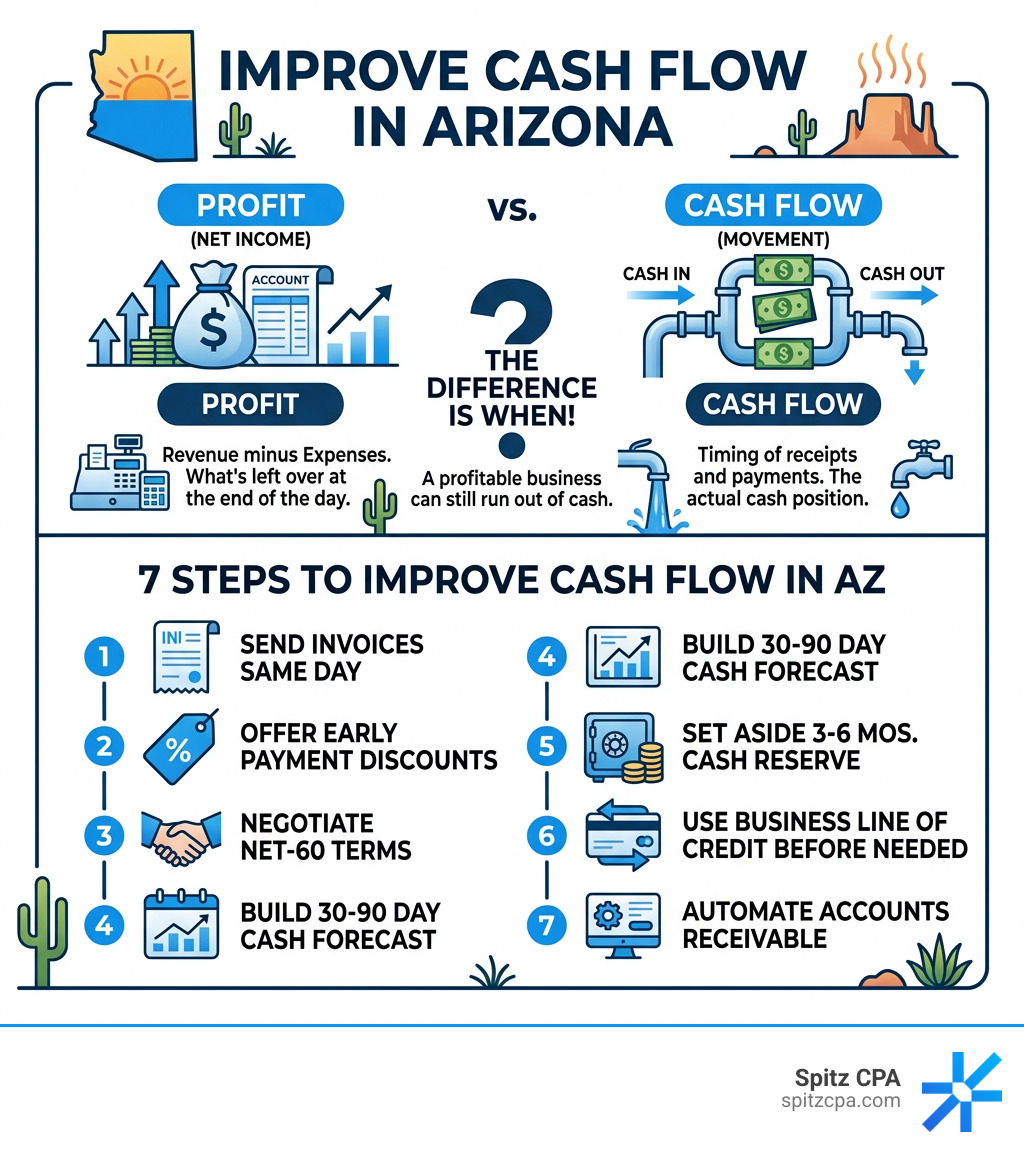
Improve cash flow AZ is one of the most urgent priorities for small business owners across the state — and for good reason. Here are the fastest ways to do it:
- Send invoices the same day work is completed
- Offer early payment discounts (e.g., 2% off if paid within 10 days)
- Negotiate Net-60 terms with your vendors
- Build a 30-90 day cash flow forecast using spreadsheets or software
- Set aside 3-6 months of operating expenses as a cash reserve
- Use a business line of credit before you actually need it
- Automate accounts receivable to cut late payments and reduce Days Sales Outstanding (DSO)
Cash flow is simply the movement of money in and out of your business. It’s not the same as profit.
A business can be profitable on paper and still run out of cash. That happens when customers pay late, fixed costs pile up, or sales slow down unexpectedly. In Arizona, where industries like construction, retail, and hospitality face sharp seasonal swings, timing mismatches between income and expenses are especially common.
Think of it this way: if you’ve ever counted the register at the end of the day wondering whether your deposit will clear before payroll hits, you already understand the problem.
Negative cash flow is one of the leading reasons small businesses close — not bad products, not lack of customers, but simply running out of money at the wrong moment.
I’m Michael J. Spitz, a Phoenix-based CPA with 15+ years of corporate accounting experience, including deep expertise in cash management, financial modeling, and budgeting that directly apply to helping Arizona businesses improve cash flow. In this guide, I’ll walk you through the most practical, proven steps to stabilize and strengthen your cash position — whether you’re just starting to feel the squeeze or want to build long-term financial resilience.
Identifying Common Cash Flow Challenges for Arizona Owners
In the Valley of the Sun, our economy has its own unique rhythm. While Arizona is a land of opportunity, business owners in Gilbert and Phoenix often face specific hurdles that can dry up liquidity faster than a mid-August afternoon.
One of the most frequent culprits is late payments. Many B2B companies in Arizona still operate on handshake agreements or vague “Net-30” terms that customers treat more like “Net-90.” When your money is sitting in a client’s bank account instead of yours, you’re effectively acting as their interest-free lender.
Then there are the high fixed costs. Rent in growing areas like the Gilbert Heritage District or the Camelback Corridor isn’t getting any cheaper. When you combine rising lease rates with increasing labor costs and the need to keep the AC blasting all summer, your “burn rate” stays high even if foot traffic drops.
Unpredictable sales cycles and seasonal fluctuations are also part of the Arizona landscape. If you’re in hospitality or retail, you know the “snowbird effect.” Revenue might soar in February during Spring Training but dip significantly in July. Without a plan to Manage Cash Flow And Increase Cash Balance, these swings can lead to a dangerous cash crunch.
Finally, we have to talk about hidden cash leaks. These are small, recurring expenses—like unused software subscriptions or inefficient inventory ordering—that slowly drain your accounts. When we perform an accounting clean-up, we often find that businesses are losing 5% to 10% of their monthly cash to these overlooked “vampire” costs.
Overcoming the “Financial Stigma” of Collections
Many small business owners feel a sense of “financial stigma” when it comes to asking for money. We want to be the “good guy” or the “helpful partner,” so we feel awkward sending that third reminder about a past-due invoice.
However, to improve cash flow AZ, we have to shift that mindset. Collecting payment isn’t being rude; it’s a vital part of a professional relationship. The best way to overcome this awkwardness is to make it systematic. This means having clear terms written into every contract and using contractual agreements that specify late fees or interest.
When the process is automated and professional, it removes the personal emotion from the transaction. By setting expectations early, you reinforce the value of your work. If you’re struggling with how to structure these processes, you can find more info about cash flow management on our site to help you get started.
Proven Strategies to Improve Cash Flow AZ
Improving your cash position doesn’t always require a massive increase in sales. Often, it’s about optimizing the money you already have.

1. 30-90 Day Forecasting
Forecasting is like turning on your headlights while driving at night. You wouldn’t drive down the I-10 at 75 mph with your lights off, so why run your business without knowing what your bank balance will look like in 60 days? We recommend creating a rolling forecast that tracks your expected inflows and outflows. This allows you to spot a potential shortfall before it happens, giving you time to adjust spending or pull from a line of credit. For a deeper dive into the math, check out our guide on the cash-flow-calculation.
2. Same-Day Invoicing
If you wait until the end of the week or—heaven forbid—the end of the month to send invoices, you are delaying your own payday. Invoicing the moment a service is rendered or a product is delivered can shave five to seven days off your payment cycle immediately.
3. Digital Payment Options and Incentives
In today’s world, paper checks are a bottleneck. They get lost in the mail, sit on desks, and require a trip to the bank. By offering digital payment options like ACH, credit cards, or even digital wallets, you make it easy for customers to pay you instantly. To sweeten the deal, offer early payment incentives. A “2/10 Net 30” discount (2% off if paid in 10 days) can be a powerful motivator for clients to move you to the top of their “to-pay” list.
4. Smart Cash Handling Tools
For our retail and restaurant clients in Gilbert and Phoenix, managing physical cash can be a major time-sink. Manual counting and daily bank runs are prone to error and theft. Modern smart safes and automated cash management tools can provide real-time visibility into your cash on hand and even give you “provisional credit” from your bank before the armored car even arrives. This speeds up your access to working capital significantly. You can find more 7 tips to improve cash flow efficiency here to help streamline your daily operations.
Using Technology to Improve Cash Flow AZ
Technology is the great equalizer for small businesses. You don’t need a massive finance department to have world-class cash visibility.
Real-time liquidity tools and ERP (Enterprise Resource Planning) integrations allow you to see your exact financial position across multiple bank accounts and platforms in one dashboard. When your CRM (where your sales happen) talks to your accounting software (where your cash is tracked), you get a “single source of truth.”
Automated AR/AP (Accounts Receivable/Accounts Payable) software can send out polite reminders to customers automatically and schedule your own bills to be paid on the very last day they are due, keeping that cash in your account for as long as possible. If you want to see what a professional-grade tracking system looks like, we have more info about 12-month cash flow statements and an example of cash flow projection for 12 months that can serve as a template.
Leveraging Local Experts to Improve Cash Flow AZ
While software is great, it doesn’t replace strategic human advice. Working with an Arizona CPA who understands the local tax environment and market trends can provide insights that a generic software package can’t.
For instance, we help our clients with treasury management and financial advisory services that go beyond just filing taxes. We look at your cash-flow-from-assets-formula to see how efficiently your equipment and property are generating cash. We also offer more info about our cash flow improvement guide to help you plan for the coming years.
Local experts can also introduce you to specialized banking tools offered by Arizona-based institutions that are tailored to the needs of Western businesses, such as construction-specific lending or hospitality-focused merchant services.
Optimizing Operations and Vendor Management
Your cash flow isn’t just about what’s in the bank; it’s about how your entire operation moves. One of the biggest “cash traps” is inventory.
Just-In-Time (JIT) vs. Traditional Inventory
Many businesses in Phoenix still use “Just-In-Case” inventory management—stocking up on everything just in case they need it. This ties up massive amounts of cash in boxes sitting on shelves. By moving toward a Just-In-Time (JIT) model, you only order what you need for current orders.
| Feature | Traditional (Just-In-Case) | Just-In-Time (JIT) |
|---|---|---|
| Cash Impact | High (Cash tied up in stock) | Low (Cash stays in bank) |
| Storage Cost | High (Warehouse/Shelf space) | Low (Minimal space needed) |
| Risk | Obsolescence/Damage | Potential supply chain delays |
| Best For | Stable, high-volume items | High-value or perishable items |
The 80/20 Inventory Rule
Often, 80% of a company’s revenue comes from just 20% of its products. If you apply this to your inventory, you might find that you are holding onto “dead stock”—items that haven’t sold in months. We recommend holding a “clearance sale” to turn that stagnant inventory back into liquid cash, even if you have to sell it at cost. It’s better to have $1,000 in the bank than $1,000 worth of Sony Walkmans in the back room!
Negotiating Vendor Terms
Don’t be afraid to ask your suppliers for more breathing room. If you’ve been a loyal customer for years, ask to move from Net-30 to Net-60 terms. This gives you an extra 30 days to sell your product before you have to pay for the materials. Conversely, if you have a surplus of cash, ask for a “fast-pay” discount. Negotiating these terms is a zero-cost way to improve business profitability.
Building Financial Resilience and Strategic Credit
In Arizona, we know that storms happen—both the haboobs that roll through in July and the economic ones that hit without warning. Building resilience is about creating a buffer.
1. Build a Cash Reserve Ideally, every business in Gilbert and Phoenix should aim for a 3-6 month buffer of operating expenses. This isn’t just for emergencies; it’s “opportunity money.” When a competitor goes out of business or a prime piece of real estate opens up, having cash on hand allows you to move fast.
2. Strategic Use of Credit The best time to get a business line of credit is when you don’t need it. If you wait until you’re in a crisis, banks will be much less likely to lend to you. Use your line of credit strategically to cover short-term gaps, but always have a plan to pay it back quickly to avoid high interest costs.
3. Revenue Stream Diversification If 90% of your revenue comes from one client or one seasonal window, your cash flow is fragile. Consider adding subscription models or “add-on” services that provide a steady, predictable monthly income. This “recurring revenue” acts as a floor for your cash flow, ensuring you can always cover your basic fixed costs.
4. Asset Leasing vs. Buying Before you drop $50,000 on a new delivery truck or piece of manufacturing equipment, consider leasing. While leasing might cost slightly more over the long term, it preserves your cash today. In a high-growth phase, cash is often more valuable than equity in a piece of machinery. Preserving that liquidity is a key part of our ultimate guide to increase business profitability.
Frequently Asked Questions about Arizona Cash Flow
How do workflow optimizations impact metrics like DSO and CCC?
Workflow optimization is just a fancy way of saying “fixing the plumbing.” When you automate your invoicing and collections, you directly impact two critical numbers:
- DSO (Days Sales Outstanding): This is the average number of days it takes to get paid. Automation can often reduce DSO from 45 days down to 28 days.
- CCC (Cash Conversion Cycle): This measures how fast a dollar spent on expenses turns back into a dollar of revenue.
By integrating your systems, you’re not just saving time; you’re literally making your money move faster. Some firms report a 70% increase in productivity just by moving away from manual spreadsheets.
What are real-world examples of successful cash flow improvement?
We’ve seen incredible transformations right here in the West. For instance, a restaurant operator with multiple locations was able to unlock $100,000 in working capital simply by switching to an automated deposit system that gave them credit for their cash sales within two business days instead of four.
In another case, a large nonprofit retailer was able to reclaim over 160 days of labor annually by automating their nightly cash reconciliation. Instead of managers spending 45 minutes every night counting bills, the system did it in five. That’s time—and money—put back into the mission of the business.
Which key performance metrics should I track monthly?
To truly improve cash flow AZ, you need to watch these five numbers every month:
- Quick Ratio: Your ability to cover short-term debts with only your most liquid assets. Aim for 1.0 or higher.
- Operating Cash Flow: Is your actual business generating cash, or are you just surviving on loans?
- Accounts Receivable Aging: How much money is 30, 60, or 90 days past due?
- Forecast Accuracy: How close was your predicted bank balance to your actual balance?
- Expense-to-Revenue Ratio: Are your costs growing faster than your income?
Tracking these metrics is essential if you want to increase business value over the long term.
Conclusion
Managing a business in Arizona is a rewarding challenge, but you shouldn’t have to stay up at night worrying about the bank balance. By implementing these strategies—from same-day invoicing to strategic forecasting—you can move from a state of “cash stress” to “financial clarity.”
At Spitz CPA, we specialize in helping Gilbert and Phoenix business owners navigate these waters. Whether you need a deep-dive accounting clean-up or ongoing strategic guidance to 10x your business value, we are here to help. Michael J. Spitz and our team are dedicated to ensuring your business isn’t just profitable, but liquid and resilient.
If you’re ready to stop guessing and start growing, we invite you to explore more info about our services and see how we can help you master your cash flow today.
Spitz CPA: Helping Arizona Businesses Thrive.


