


Core Financial Advice for Young Adults: The High-Impact Priority Stack
Building wealth in your twenties is rarely about finding a secret investment strategy or picking individual winning stocks. Instead, early financial success comes from executing a specific sequence of cash moves that maximize your guaranteed returns and eliminate wealth-destroying interest. Only forty-nine percent of American adults can answer basic personal finance questions correctly, and nearly one in four adults has no emergency savings whatsoever. When you understand how money flows through different accounts and obligations, you can make decisions that yield thousands of dollars in measurable value during your very first year in the workforce.
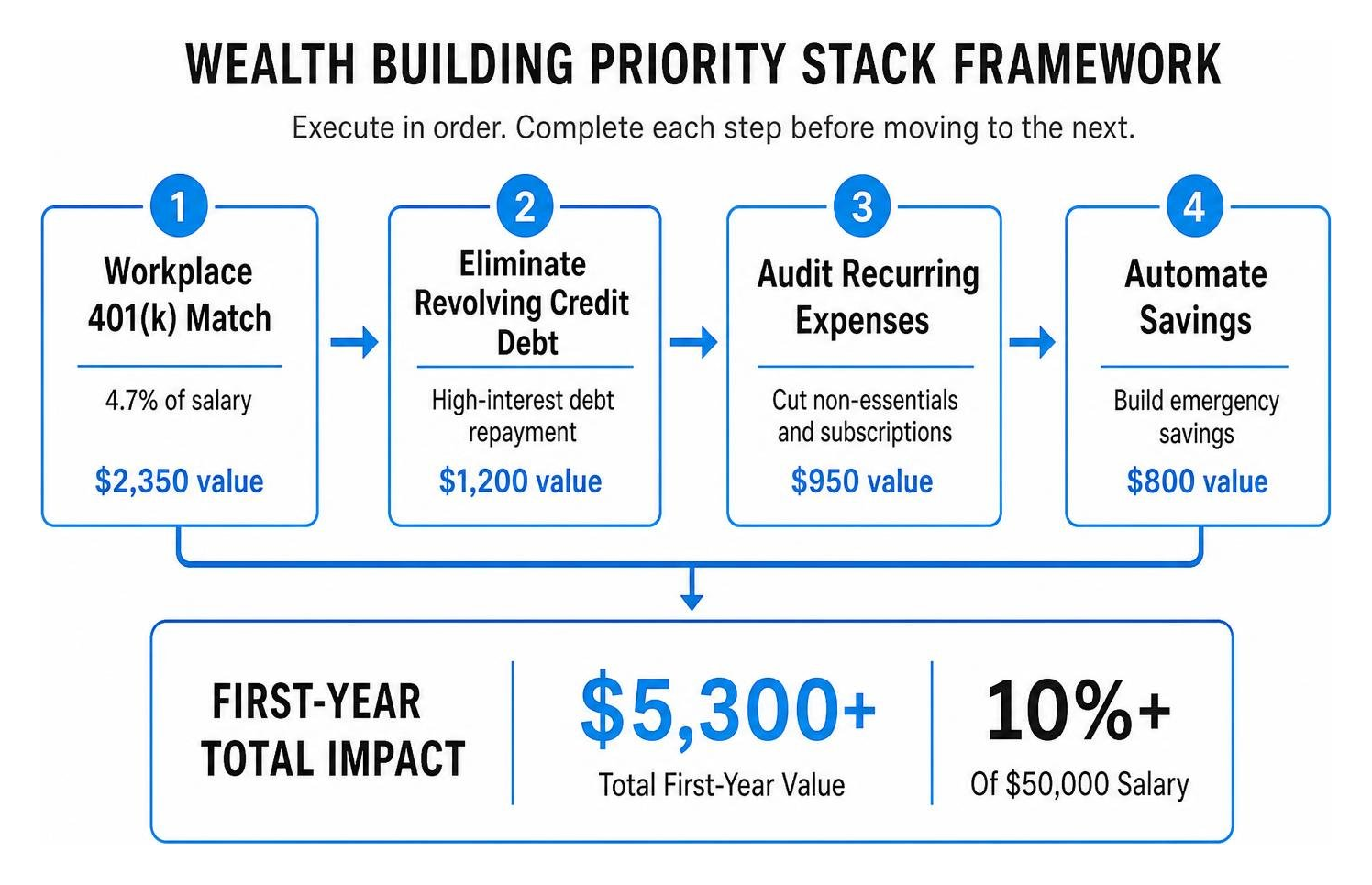
Understanding the exact dollar value of each financial step helps eliminate decision fatigue. When a twenty-four-year-old earning an entry-level salary of $50,000 optimizes workplace retirement matches, eliminates revolving credit debt, audits recurring expenses, and automates savings, the combined first-year value can exceed $5,300. This represents more than ten percent of their entire annual salary recovered through structural efficiency alone.
| Financial Move | First-Year Dollar Impact ($50k Salary) | Mechanism of Return | Risk Level | Priority Level |
|---|---|---|---|---|
| Workplace 401(k) Match (4.7%) | $2,350 | 100% immediate employer match | Zero (Guaranteed) | Tier 1 (Immediate) |
| Pay Off $4,000 Card Balance (22.15% APR) | $886 | Direct interest avoidance | Zero (Guaranteed) | Tier 1 (Immediate) |
| Credit Score Optimization (601 to 661+) | $633 | Auto loan APR reduction from 14.03% to 8.77% | Zero (Guaranteed) | Tier 2 (Short-Term) |
| Subscription & Expense Audit | $480 | Eliminating $40/month in unused recurring charges | Zero (Guaranteed) | Tier 2 (Short-Term) |
| Automatic 50% Raise Allocation | $972 | Banking half of an average 4% annual raise | Zero (Guaranteed) | Tier 3 (Ongoing) |
| Total First-Year Financial Value | $5,321 | Combined structural cash flow improvements | Zero (Guaranteed) | Baseline Total |
First-Year Cash Moves Ranked by Real Dollar Value
The highest-yielding financial move available to any working professional is capturing every cent of their employer-sponsored retirement match. With the average employer matching contribution reaching 4.7% of gross salary, an individual earning $50,000 leaves an immediate $2,350 in free compensation on the table if they fail to participate. Because an employer match provides an instant fifty to one hundred percent return on your contributed funds, no other standard investment vehicle can compete with its guaranteed performance. Capturing this workplace benefit is the absolute baseline of practical financial moves for early adulthood.
The second most impactful move is eliminating high-interest revolving credit card debt. With the average credit card annual percentage rate reaching 22.15% in 2026, carrying a typical $4,000 balance drains roughly $886 in pure interest charges every twelve months. Paying off that balance produces a guaranteed, risk-free after-tax return of 22.15%, which easily outperforms the historical average ten percent annual return of broad equity markets.
Following debt reduction, optimizing your credit profile before securing major financing provides substantial annual cash savings. On a standard $20,000 used car loan, moving your credit score from a near-prime tier with an average rate of 14.03% into a prime tier averaging 8.77% saves $633 in first-year interest charges alone. Young professionals should also audit their monthly bank statements, as consumers routinely underestimate subscription costs by more than one hundred dollars per month, with forty-two percent continuing to pay for services they no longer use. Finally, committing to bank fifty percent of every future salary increase before that money hits your primary checking account permanently protects your growing income from lifestyle creep.
Building a Starter Emergency Buffer Versus Full Living Reserves
While standard financial advice often recommends saving three to six months of living expenses immediately, setting such an aggressive target can backfire for an entry-level earner. Attempting to accumulate $15,000 right out of school can feel overwhelming, leading many young adults to abandon saving altogether. Instead, the most practical approach is establishing an immediate $1,000 starter emergency buffer in an independent high-yield savings account before tackling high-interest debt or aggressive market investing.
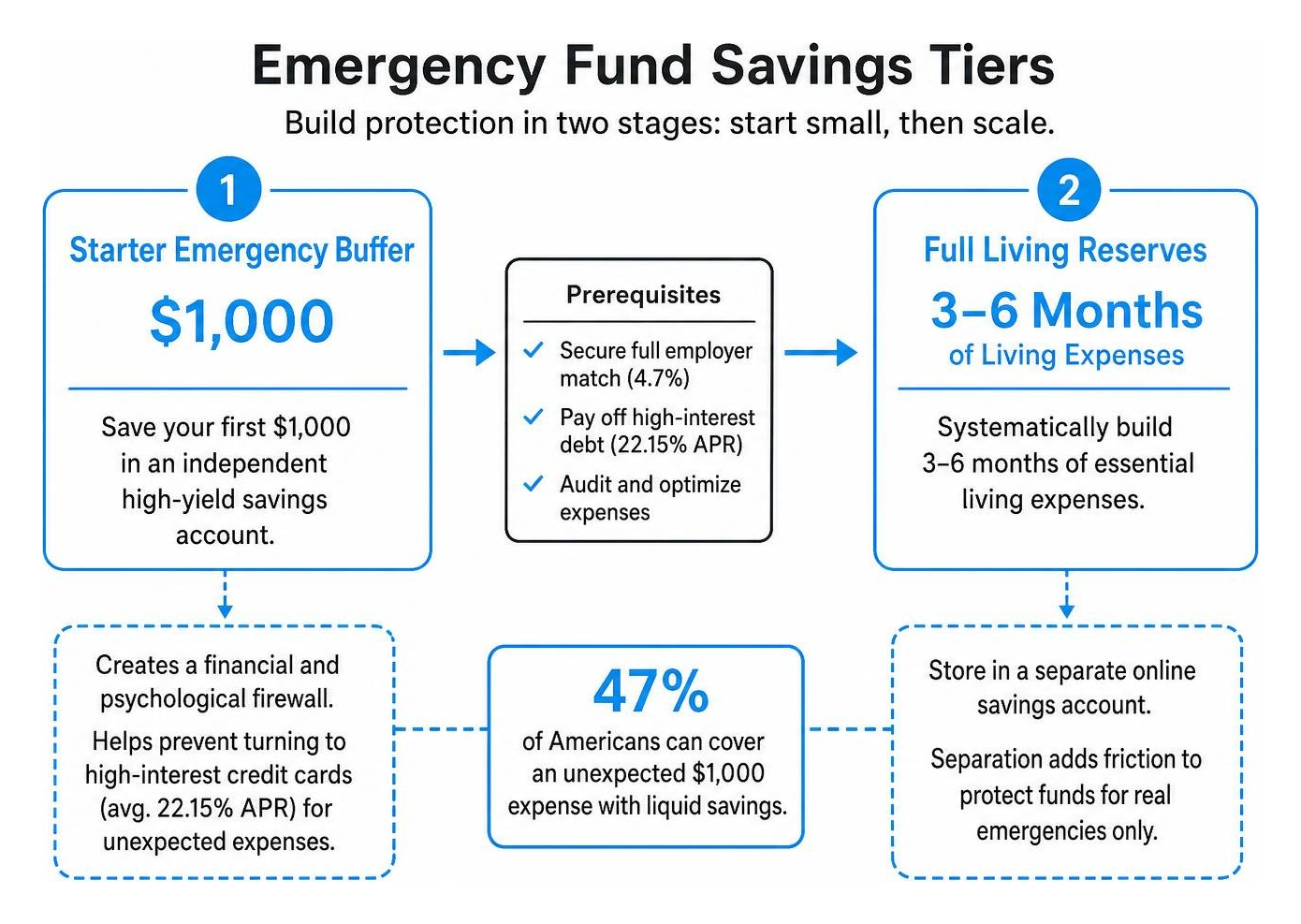
This $1,000 buffer creates a vital psychological and financial firewall between your daily life and your credit cards. When an unexpected car repair or emergency dental visit occurs, having accessible cash prevents you from turning to revolving credit lines that accrue twenty-two percent interest. Only forty-seven percent of Americans can cover an unexpected $1,000 expense with liquid savings, leaving the remainder vulnerable to recurring debt cycles.
Once your toxic debts are eliminated and your employer match is fully secured, you can systematically expand this starter reserve into a full three-to-six-month living cushion. To prevent accidental spending, store your emergency reserves in a dedicated online savings institution separate from your day-to-day checking account. This separation introduces beneficial friction, ensuring that liquid funds remain fully preserved for genuine financial emergencies.
Navigating Cash Flow, Banking, and Debt Management
Gaining complete command over your personal finances requires a sustainable cash management system that operates automatically. When money enters your primary checking account, it should follow clear, predefined paths rather than relying on daily willpower. Structuring your banking into distinct buckets for daily essentials, emergency reserves, and future goals ensures you always know where your money is going.
Essential Financial Advice for Young Adults on Budgeting and Spending
The simplest and most resilient budgeting framework for entry-level professionals is the 50/30/20 rule, which categorizes after-tax net income into three distinct pillars. Fifty percent of take-home pay is allocated toward absolute living needs such as rent, basic groceries, utilities, transit, and minimum debt payments. Thirty percent is reserved for discretionary lifestyle spending, including dining out, entertainment, and personal hobbies, while the remaining twenty percent is dedicated directly to savings, investments, and debt acceleration.
For individuals facing variable entry-level earnings or high living costs, proactive cash flow management prevents month-end deficits. Maintaining a forward-looking perspective on upcoming irregular obligations is essential, which is why understanding budgeting vs forecasting helps young adults separate routine monthly bills from larger, anticipated annual expenses.
Preventing lifestyle creep is the single most important habit for maintaining long-term financial margin. As your career progresses and your base compensation rises, living expenses naturally tend to expand to match your new income level. By establishing an automated rule to route at least half of every net salary increase directly into automated investment accounts, you can enjoy a higher standard of living while simultaneously accelerating your timeline toward financial independence.
Eradicating Toxic Credit Card Balances and Optimizing Credit Scores
Carrying a rolling balance on a credit card is one of the most expensive financial traps facing young adults today. Because interest compounds daily on unpaid revolving balances, minimum payments primarily cover financing charges rather than reducing principal. If you are managing multiple credit obligations, using structured payoff strategies like the debt avalanche—which directs all surplus payments to the highest-interest balance first—minimizes total borrowing costs. Alternatively, the debt snowball method focuses on eliminating the smallest account balance first to generate early behavioral momentum.
Your credit score serves as a financial resume that affects apartment leasing approvals, insurance premiums, and borrowing interest rates throughout adulthood. Payment history represents thirty-five percent of your FICO score, making on-time payments non-negotiable. Credit utilization, which measures the ratio of your reported credit balances against your total credit limits, accounts for another thirty percent of your score.
To maintain optimal credit health, aim to keep your credit utilization below ten to thirty percent across all open cards, and set up automatic payments to clear the entire statement balance each billing cycle. Young adults entering the workforce should also consider placing a free credit freeze across all three major credit reporting bureaus to protect against identity theft and unauthorized account creation.
Early Investing, Account Types, and Compounding Leverage
The single greatest financial asset available to a young adult in their twenties is not a massive starting salary, but an expansive time horizon. When investments are given thirty to forty years to compound, the geometric growth of reinvested earnings vastly outweighs the actual out-of-pocket cash contributed.
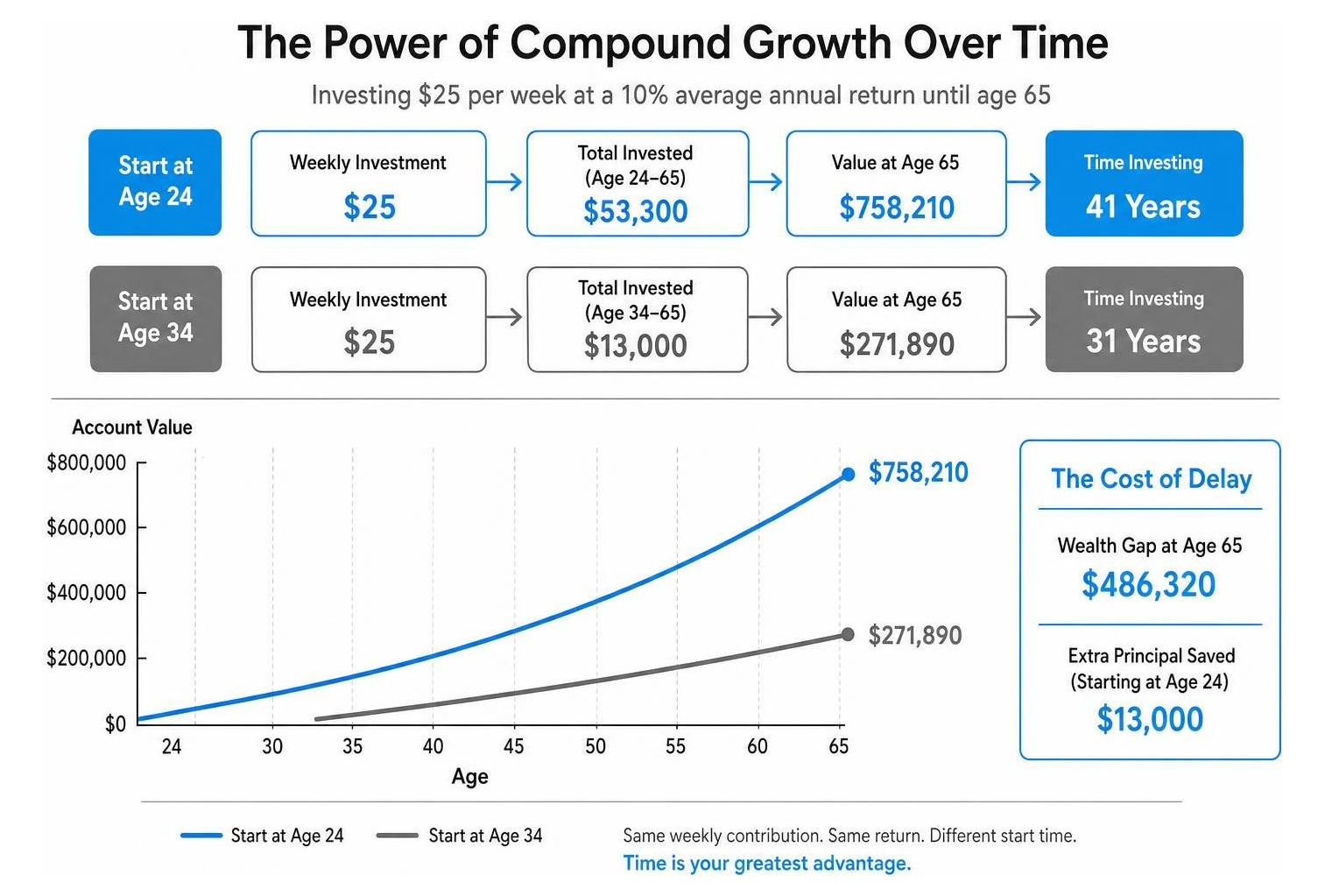
Understanding the long-term impact of compound growth highlights the immense cost of delay. For example, investing just $25 per week starting at age twenty-four until age sixty-five at an average ten percent annual return accumulates roughly $758,210 from $53,300 in out-of-pocket deposits. Delaying that exact same $25 weekly contribution by ten years to age thirty-four results in a nest egg of only $271,890 at age sixty-five, creating a wealth deficit of nearly $486,320 over an extra $13,000 in saved principal.
Advanced Financial Advice for Young Adults on Investing and Wealth Building
A common misconception among beginner investors is confusing an investment account with the underlying investment asset. Opening a brokerage or retirement account simply establishes a legal and tax container; you must still actively allocate your deposited cash into productive assets. Young investors should avoid speculative stock picking, active day trading, and complex financial products that charge high management fees. Exploring beginner investing strategies reveals that broad-market diversification consistently outperforms active stock selection over long horizons.
For most individuals with decades ahead of them, a low-cost target-date index fund or a simple three-fund portfolio consisting of total domestic stock, international stock, and modest bond index funds provides optimal diversification. Target-date funds automatically adjust their asset allocation along a gradual glide path, shifting from aggressive equity growth in your twenties to conservative capital preservation as you near retirement. By focusing on low-cost index funds with expense ratios below 0.10%, you avoid paying unnecessary management fees that erode compound growth over time.
Workplace 401(k) Matching, Roth IRAs, and Health Savings Accounts
Tax-advantaged accounts are powerful wealth-building tools because they protect your investment gains from immediate taxation. For 2026, the IRS employee deferral limit for workplace retirement plans such as 401(k)s and 403(b)s is $24,500, while the annual contribution limit for Individual Retirement Accounts is $7,500. For most young professionals in lower tax brackets, funding a Roth IRA is especially advantageous because contributions are made with after-tax dollars, allowing all future capital gains and retirement withdrawals to be completely tax-free.
Health Savings Accounts, when paired with an eligible High-Deductible Health Plan, offer a rare triple-tax advantage: contributions are pre-tax or tax-deductible, investments grow tax-free, and withdrawals for qualified medical expenses are never taxed. For 2026, the HSA contribution limit is $4,400 for self-only coverage and $8,750 for family coverage. Healthy young adults can invest their HSA balances in low-cost equity index funds while paying minor out-of-pocket medical expenses from cash flow, transforming their health plan into an auxiliary long-term investment vehicle. Mastering these foundational personal finance principles ensures every earned dollar works efficiently across all stages of adulthood.
Tax Optimization, Paycheck Literacy, and Major Life Decisions
Transitioning to financial independence requires learning how to read your earnings statements and evaluate large, long-term contractual commitments. A first professional salary can look very different once mandatory payroll taxes and employee benefit deductions are taken into account.

Understanding Paycheck Withholdings, Deductions, and FICA Taxes
When reviewing your pay stub, understanding the spread between gross earnings and take-home net pay is essential. Beyond federal and state income tax brackets, mandatory FICA payroll withholdings deduct 6.2% of your compensation for Social Security and 1.45% for Medicare, which is matched equally by your employer.
Reviewing your IRS Form W-4 ensures your employer does not withhold too much or too little tax from each paycheck. While receiving a large tax refund can feel like a bonus, it simply means you provided the government with an interest-free loan throughout the year. For the 2026 tax year, the standard deduction is $16,100 for single filers and $32,200 for married couples filing jointly. Young earners should familiarize themselves with above-the-line tax deductions, such as the student loan interest deduction, which allows eligible taxpayers to deduct up to $2,500 in paid loan interest directly from their gross income.
Evaluating Housing Costs, Transportation, and Student Loans
Major fixed expenses dictate your monthly savings margin more than daily discretionary habits. When renting your first independent apartment, keeping total housing costs below thirty percent of your gross income prevents you from becoming house-poor. Factor in recurring utility bills, internet services, security deposits, and mandatory renter’s insurance policies, which provide vital property and liability coverage for minimal annual cost.
Transportation is another category where young adults frequently overspend. Purchasing an expensive new vehicle with an extended loan term locks you into steep depreciation, higher insurance premiums, and elevated interest expenses. Evaluating a vehicle based on its total cost of ownership—including financing interest, state registration fees, routine maintenance, fuel, and insurance—ensures your commute does not derail your retirement savings.
For those managing educational debt, understand the interest rates and terms on each individual loan. Federal student loans offer flexible repayment structures, such as income-driven repayment plans, which adjust monthly obligations based on your earnings. If your federal or private student loan interest rates are below five percent, prioritize employer 401(k) matches and high-yield emergency savings before making aggressive extra principal payments.
Frequently Asked Questions About Personal Finance in Your 20s
How much money should a young adult have saved by age 25 and 30?
A helpful baseline is accumulating a liquid emergency fund covering three to six months of essential living expenses, alongside reaching one-half of your annual salary in total retirement assets by age twenty-five. By age thirty, aiming to have the equivalent of one full year’s gross salary saved across tax-advantaged retirement accounts keeps you on track for long-term financial security. If student loans result in a negative net worth in your early twenties, track your liquid emergency savings and retirement contributions separately to maintain positive financial momentum.
Should I pay off student loans or invest in the market first?
Your repayment order should be determined by the interest rate on each specific loan balance. Always capture your full employer 401(k) match first, as it offers an immediate fifty to one hundred percent return that outpaces any debt interest rate. After capturing the match, focus extra cash flow on paying down high-interest debts with interest rates exceeding seven percent, such as credit cards and private loans. For low-rate loans below five percent, making standard monthly payments while directing surplus cash into broad-market index funds historically yields higher lifetime wealth.
What is the most effective way to start investing with a small income?
Modern discount brokerages offer fractional share investing with zero account minimums, allowing you to begin building an investment portfolio with as little as $5 or $25 per week. Set up an automated recurring transfer from your checking account into a low-cost broad-market index fund on every payday. Consistently investing small, manageable amounts builds lifelong investing discipline and harnesses the power of dollar-cost averaging without straining your day-to-day living budget.
Conclusion
Mastering personal finance in early adulthood does not require complex market strategies or severe deprivation. By executing high-impact financial moves in the correct mathematical order—capturing workplace retirement matches, eliminating expensive revolving debt, establishing a dedicated cash emergency buffer, and automating your long-term investments—you build a foundation for lasting financial independence.
As a professional accountant and founder, Michael J. Spitz emphasizes that long-term wealth is built on consistent systems, structured cash flow, and tax efficiency. If you are navigating business ownership, complex tax considerations, or long-term wealth planning, our team at Spitz CPA provides comprehensive guidance. Explore our professional Spitz CPA financial advisory services to establish a clear, structured roadmap for your financial future.


