


Why Understanding R&D Is Critical for Your Business Success
What is R&D in business is a question that goes far beyond laboratories. Research and Development (R&D) refers to the systematic activities businesses undertake to innovate—creating new products, improving existing services, or developing more efficient processes. It’s the engine that drives long-term competitive advantage.
Many business owners miss that R&D isn’t just for giants like Amazon or Apple. If you’ve ever adapted a product, developed internal software, or improved a manufacturing process, you’ve likely conducted qualifying R&D. The challenge is that an estimated 97% of eligible businesses fail to claim valuable tax credits, leaving significant money on the table.
The R&D tax credit can provide a dollar-for-dollar tax reduction, and businesses can claim up to $500,000 against payroll taxes. Even failed projects can qualify if they sought to resolve technical uncertainty. However, the landscape has changed. Since 2022, the Tax Cuts and Jobs Act requires companies to capitalize and amortize R&D expenses over five years (or fifteen for foreign research), making proper accounting more critical than ever.
I’m Michael J. Spitz, and with over 15 years of corporate accounting experience, I’ve seen how a clear understanding of R&D can open up significant financial benefits. This guide will help you recognize and capitalize on R&D opportunities in your business.
Defining Research and Development (R&D)
Research and Development isn’t just for scientists in lab coats. In practical terms, what is R&D in business is any systematic effort to create something new or improve what you already have—a product, a service, or an internal process. It’s the innovation engine that keeps your business moving forward, whether you’re a small business in Gilbert, Arizona, testing new service approaches or a tech giant developing a new device. What separates R&D from daily operations is the systematic approach: following a process, documenting results, and building on that knowledge.
The Three Core Types of R&D
Understanding these categories helps you recognize R&D activities in your own business.
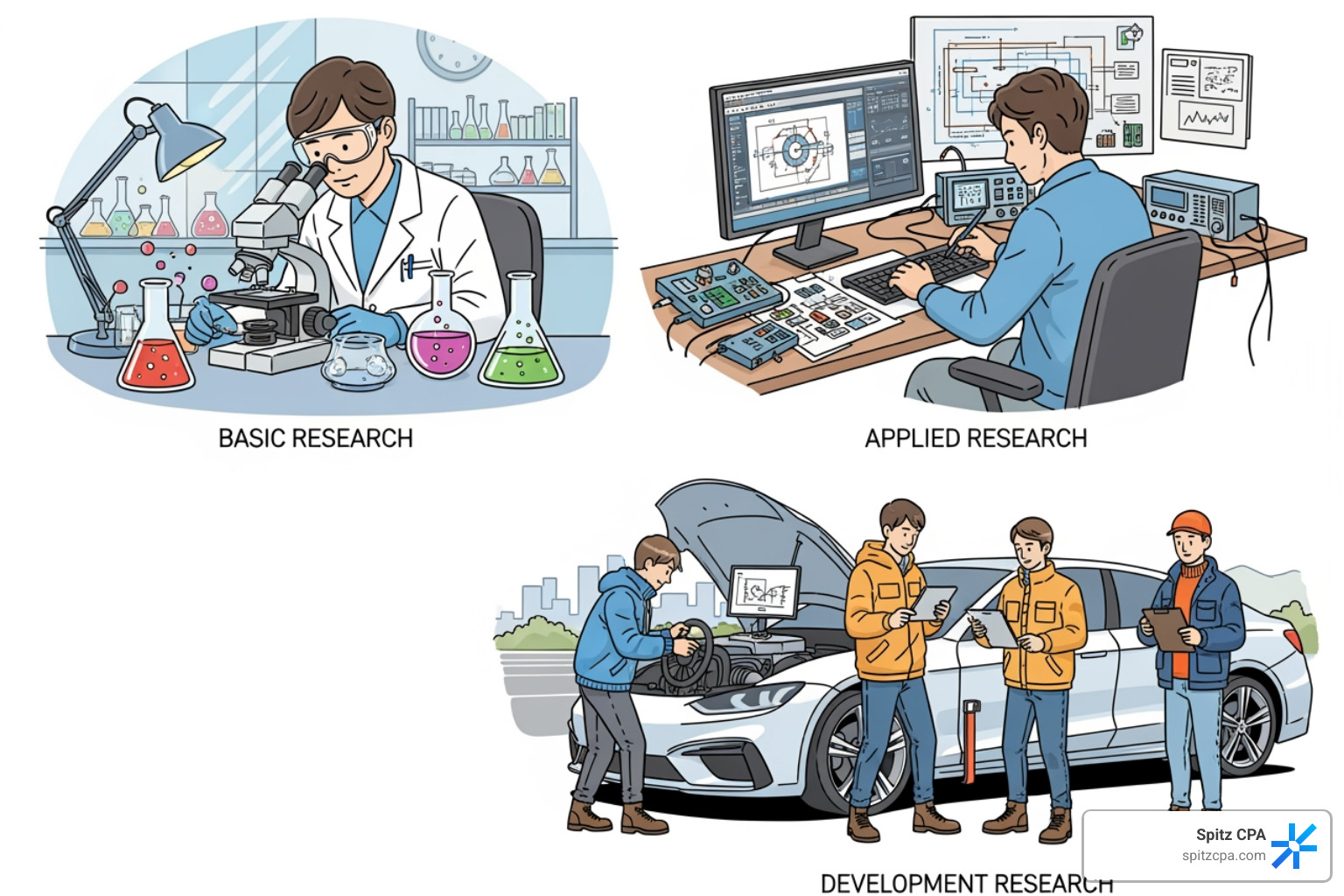
- Basic Research: This is about finding fundamental knowledge without an immediate commercial goal, often conducted at universities. It expands knowledge for its own sake and provides building blocks for future innovations.
- Applied Research: This is more practical, using scientific knowledge to solve a specific problem or achieve a commercial objective. It asks, “How can this theoretical knowledge solve a real-world challenge?”
- Development Research: This is where ideas become tangible. It involves creating prototypes, testing products, and refining processes to move from concept to reality. Most small and medium-sized businesses focus their efforts here.
The R&D Process in Action
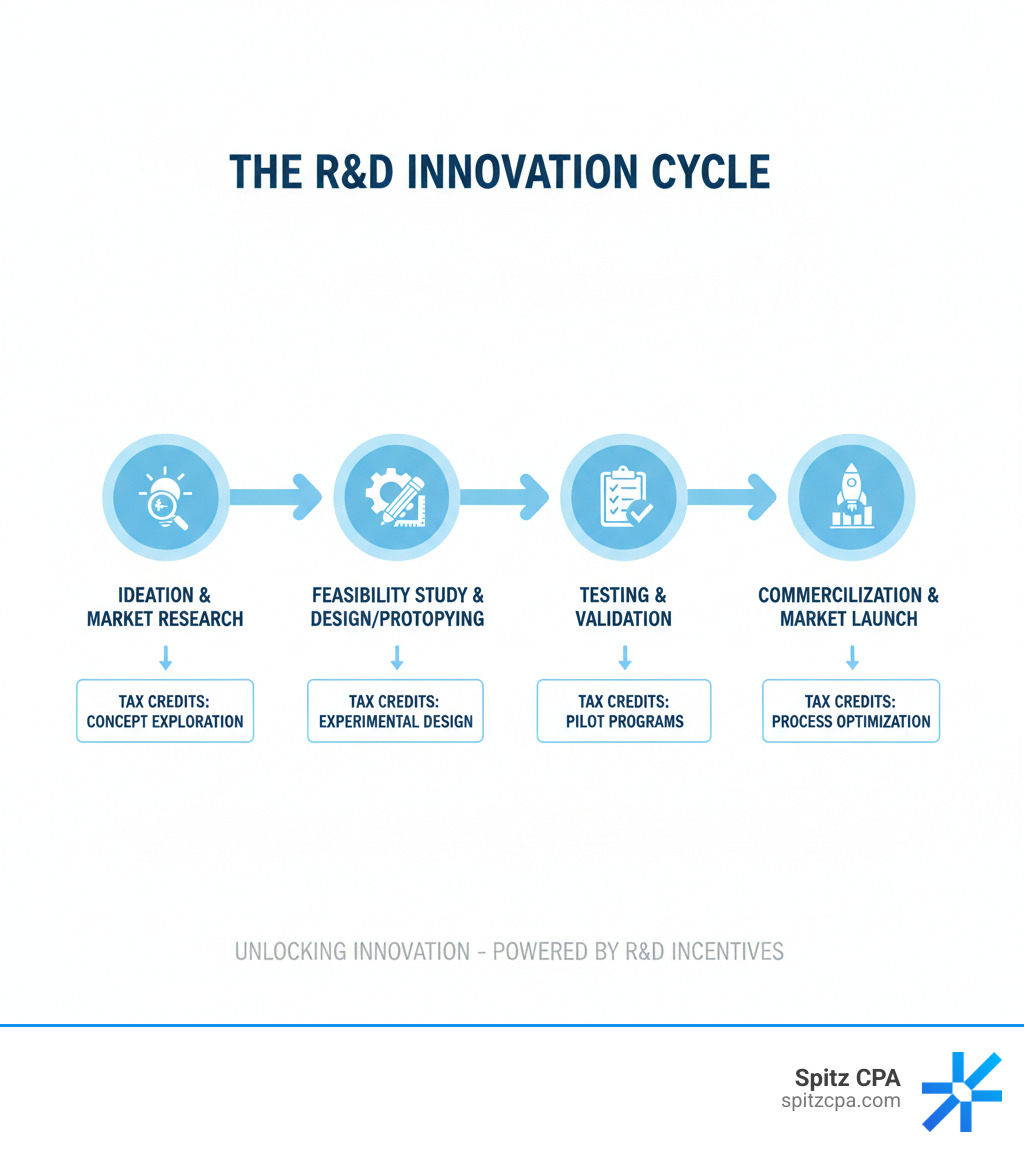
Most innovations follow a general roadmap, and documenting these stages is key for tax benefits.
- Ideation & Market Research: The process starts with an idea to solve a problem, followed by research to validate that a market for the solution exists.
- Feasibility Study: You ask the tough questions: Can we build this? What will it cost? Is it technically viable?
- Design & Prototyping: Concepts become real as you create specifications and build initial versions. This is where technical uncertainty—a key requirement for R&D tax credits—is most apparent.
- Testing & Validation: This iterative phase involves putting prototypes through their paces, identifying flaws, and making improvements. This trial-and-error process is exactly what qualifies as R&D.
- Commercialization: The innovation is brought to market through scaled-up production and marketing.
You don’t need to complete all stages for your work to qualify as R&D. Even abandoned projects count if you were attempting to resolve technical uncertainty.
The Strategic Importance of R&D for Business Growth
R&D isn’t a luxury—it’s the foundation of long-term survival. For any business, from a manufacturer in Gilbert to a software startup in Phoenix, investing in R&D is what separates thriving companies from those that merely survive. It’s a proactive response to a market that never stands still.
How R&D Fuels Innovation and Competitive Advantage
Strategically, R&D is about creating sustainable competitive advantages. It allows you to gain a first-mover advantage by defining a new category and capturing market share early. More importantly, it helps you solve customer problems better than anyone else, creating value that commands a premium. Sometimes, R&D can even create entirely new markets, as the smartphone did. Internally, R&D drives operational efficiency by streamlining processes, automating tasks, and reducing waste, which directly improves your bottom line. Finally, it helps you diversify revenue streams, making your business more resilient to market shifts. Businesses that accept R&D are simply better positioned to adapt, lead, and profit.
Real-World Examples of R&D
R&D is more common and accessible than you might think.
- Technology: Tech giants like Amazon and Apple spend billions annually on R&D, pushing boundaries in cloud computing, AI, and chip architecture.
- Consumer Goods: A skincare company testing new, stable formulations or a food manufacturer experimenting with healthier snack recipes are both conducting R&D.
- Manufacturing: A plant developing automation systems or a construction firm investigating sustainable building materials is engaged in R&D to improve margins and quality.
- Software Development: Creating custom internal software to streamline operations or building a new customer-facing mobile app is a very common form of R&D.
- User Experience (UX): The iterative process of prototyping, testing, and refining a software interface to make it more intuitive is also qualifying R&D.

The common thread is a systematic effort to create or improve something in the face of technical uncertainty. It requires experimentation, and that’s the essence of R&D, regardless of your industry.
The Financials of Innovation: R&D Costs, Funding, and Accounting
Brilliant ideas don’t mean much if you can’t fund them or account for them properly. From a financial perspective, R&D is a significant investment with uncertain immediate returns, but one that builds future capabilities. For our clients in Arizona, understanding the financial side of R&D is just as important as the innovation itself.
What is R&D in business accounting?
The accounting treatment for R&D has become more complex. Under Generally Accepted Accounting Principles (GAAP), R&D costs are typically expensed in the year they’re incurred. However, costs for assets with alternative future uses or certain internal-use software may need to be capitalized and expensed over time through amortization.
A major change came from the Tax Cuts and Jobs Act (TCJA). For tax years beginning after December 31, 2021, companies must capitalize and amortize all Specified Research or Experimental (SRE) expenditures—including software development—over five years for domestic R&D (or fifteen for foreign R&D). You can no longer deduct these costs immediately, which significantly impacts taxable income and cash flow. Successful R&D also creates valuable intangible assets like patents and copyrights, which are capitalized on your balance sheet.
Michael J. Spitz emphasizes this point: “Accurate accounting for R&D is not just about compliance; it’s about optimizing your financial position and maximizing available tax benefits. The rules have changed, and proactive planning is key.”
How Businesses Can Fund R&D Efforts
Securing funding is a major challenge, but you have several options.

- Internal Funding: Using retained earnings gives you maximum control but is limited by available capital.
- Government Grants: Non-dilutive funding is available through federal programs like SBIR/STTR and state-level incentives like the Research and Development Tax Credit Program for Business in AZ.
- Strategic Partnerships: Collaborating with academic institutions provides access to labs and expertise at a lower cost.
- Venture Capital: High-growth startups can secure substantial funding in exchange for equity.
- Crowdfunding: A creative option for raising capital directly from potential customers, which also validates market interest.
A strategic mix of funding sources is often the most effective approach to mitigate financial risk.
Common R&D Challenges for Businesses
The path to innovation has several common problems.
- Limited Resources & Budget Constraints: Smaller businesses especially face a constant tension between short-term needs and long-term R&D investment.
- Securing Funding: Navigating the complex landscape of grants and loans is time-consuming and competitive.
- Protecting Intellectual Property: Safeguarding innovations through patents and copyrights is essential but can be complex and costly.
- Risk of Failure: Not all projects succeed, which can lead to financial losses. However, even failed projects provide valuable lessons and can still qualify for R&D tax credits.
Michael J. Spitz often tells clients, “The key is to view R&D not as an optional expense, but as a calculated investment. With proper planning and understanding of the financial incentives, these challenges become manageable stepping stones to innovation.” These challenges are real, but with the right strategy and expert guidance on R&D accounting and R&D tax services, they are not impossible.
What is R&D in Business for Tax Purposes? A Guide to Credits and Incentives
The U.S. government wants to reward you for innovating. When we discuss what is R&D in business for tax purposes, we’re talking about one of the most valuable—yet underused—financial incentives available. The federal R&D tax credit (Credit for Increasing Research Activities, Section 41) is a dollar-for-dollar reduction in your tax liability, not just a deduction. A $50,000 credit means $50,000 directly off your tax bill. This incentive creates a “virtuous cycle of innovation,” where tax savings are reinvested into further research. Despite this, an estimated 97% of eligible businesses fail to claim these credits, often because they don’t realize their everyday activities qualify.
Who Qualifies for the R&D Tax Credit?
The IRS uses a four-part test to determine if an activity qualifies. Your project must meet all four criteria:
- Permitted Purpose: The goal must be to develop a new or improved product, process, technique, invention, or software. The intent matters, not the success of the project.
- Technical Uncertainty: You must face a challenge where the outcome or the method to achieve it isn’t known at the outset. If the solution was obvious, it doesn’t qualify.
- Process of Experimentation: You must systematically evaluate alternatives to resolve the uncertainty. This involves trial and error, testing, and modeling to find what works.
- Technological in Nature: The work must rely on principles of engineering, physical sciences, biological sciences, or computer science.
A game-changer for small businesses is the ability for qualifying companies (generally those with under $5 million in gross receipts) to claim up to $500,000 of the credit against their payroll taxes as of 2025. This means even pre-profit companies can get a cash-flow benefit. Arizona also offers its own Research and Development Tax Credit Program, which is why working with R&D Tax Experts is so valuable for maximizing both federal and state benefits.
How to Claim R&D Tax Credits
Claiming the credit requires a systematic approach and proper documentation.
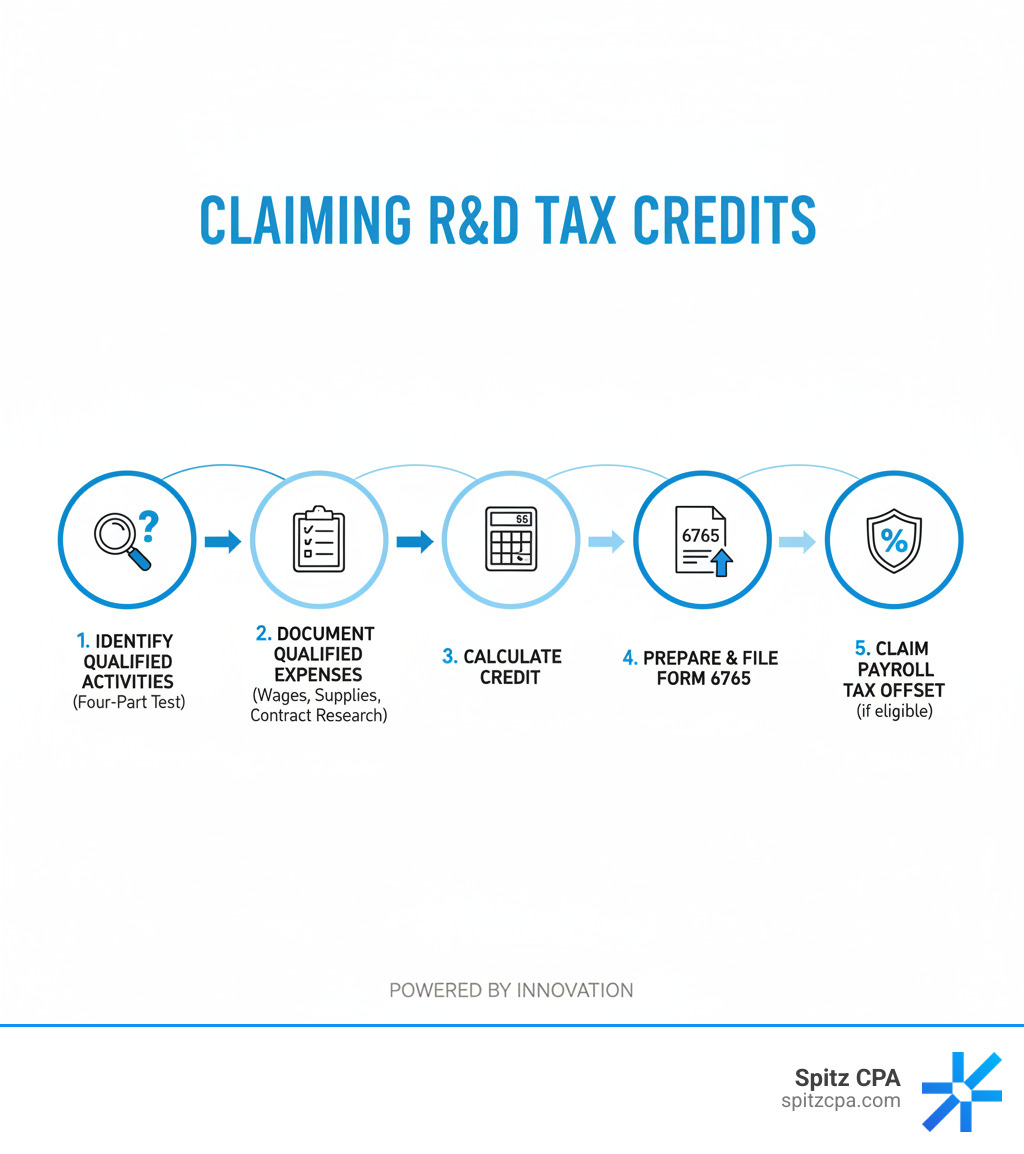
First, identify your qualifying expenses, which include:
- Wage Costs: Salaries for employees directly involved in, supervising, or supporting research.
- Supply Costs: Materials consumed during the research process.
- Contract Research Expenses: 65% of amounts paid to third parties for qualified research.
- Computer Lease/Rental Costs: For computer time used in research.
The credit calculation can be complex, typically ranging from 6% to 8% of qualifying expenses. Our R&D Tax Credit Calculation: The Complete Guide explains this in detail. To claim the credit, you must file IRS Form 6765 with your tax return.
The payroll tax offset is especially valuable for eligible small businesses, allowing them to apply the credit quarterly for an immediate cash flow boost. Documentation is critical, as the IRS scrutinizes these claims. Michael J. Spitz advises, “The worst time to start documenting your R&D is when you’re trying to claim the credit. Start tracking projects, time, and expenses as they happen.” Engaging specialists in R&D Tax Services ensures you maximize your credit while maintaining compliance.
Building an R&D Culture That Drives Your Business Forward
Technical definitions and financial incentives are only part of the story. What is R&D in business from a cultural perspective? It’s an environment where innovation is a way of thinking for everyone, not just a single department. The companies that excel at R&D are those where everyone feels empowered to ask “what if?”
Building this culture rests on several key pillars:
- Leadership Support: It starts at the top. When leaders actively champion innovation, allocate resources, and show genuine curiosity, they signal that R&D is a priority.
- Strategic Alignment: Innovation for its own sake is expensive. The most impactful R&D is directly connected to solving customer problems and advancing your business goals.
- Employee Empowerment: Give your team the time, training, and freedom to explore new ideas. Some of the best breakthroughs come from unexpected places.
- Celebrate Experimentation: You must make it safe to fail. Unsuccessful projects provide valuable lessons and still qualify for tax credits. When teams don’t fear failure, they innovate boldly.
- Customer Feedback Loops: Weave customer engagement directly into your R&D process through surveys, interviews, and beta testing. This ensures you’re solving real problems.
- Cross-Functional Teams: Break down silos. When engineering, sales, and customer service collaborate, diverse perspectives spark breakthrough solutions.
Michael J. Spitz often reminds clients: “Building an R&D culture isn’t a one-time project. It’s an ongoing commitment to curiosity, learning, and improvement. The companies that accept this mindset don’t just survive—they define their industries.”
Frequently Asked Questions About R&D in Business
We work with business owners across Arizona who are often surprised to learn what counts as R&D. Let’s clear up some common confusion about what is R&D in business.
Can a small business without a lab conduct R&D?
Absolutely. The “white lab coat” stereotype is a myth that has cost small businesses millions in unclaimed tax credits. R&D happens anywhere you are systematically trying to improve. If you’ve spent time improving a production line, building custom internal software, or developing a new service delivery framework, you’ve likely conducted R&D. Even outsourcing research to a specialist to solve a technical problem for your business can qualify. The setting doesn’t matter; the systematic attempt to resolve technical uncertainty does.
Does my R&D project have to succeed to qualify for tax credits?
No. This surprises almost everyone. The IRS focuses on the process, not the outcome. As long as you set out to resolve a technical uncertainty through a process of systematic experimentation (testing, trial and error, etc.), the associated expenses can qualify. A failed project that provided valuable learning is still considered qualified research. The government recognizes that risk and failure are inherent parts of innovation.
What is the difference between R&D and quality control?
This is a key distinction. R&D seeks new knowledge to create something that doesn’t exist or improve something in a new way. It involves uncertainty. Quality control (QC) tests against existing standards to ensure consistency and conformity. It involves verifying that a product or process meets known specifications. For example, developing a new recipe is R&D testing each batch of that perfected recipe is QC. Only the R&D activities, where you face and resolve technical challenges, qualify for tax credits.
Conclusion: Making R&D Your Engine for Growth
Understanding what is R&D in business is about recognizing the powerful engine for growth already at work in your company. Every time you’ve wrestled with a technical challenge or experimented with a better process, you’ve been conducting R&D.
This innovation doesn’t just drive your business forward—it can put real money back in your pocket. The federal R&D tax credit offers a dollar-for-dollar tax reduction, and for qualifying small businesses, a payroll tax offset of up to $500,000 can significantly improve cash flow. Yet, an estimated 97% of eligible businesses never claim these credits, often because they don’t realize their everyday problem-solving qualifies.
With recent tax law changes requiring R&D expenses to be capitalized and amortized, strategic financial planning is more critical than ever. At Spitz CPA, Michael J. Spitz and our team specialize in helping businesses uncover these hidden opportunities. Your innovation deserves to be rewarded, and we are passionate about ensuring you receive every benefit you’ve earned.
Don’t let another year pass without exploring whether your business qualifies for R&D tax credits. Expert guidance can make all the difference.


