


Exit Strategy Planning Starts With Your Goals, Value, and Timeline
Exit strategy planning means deciding how you will eventually transfer, sell, or close your business, then improving the company so that transition can happen on your terms. Start by defining the income you need after exit, your preferred timeline, the people or buyers you want to consider, and the role you want to have once ownership changes. Then obtain a realistic valuation, identify the gaps between today’s value and your financial target, and create a written plan to improve the areas buyers and successors can verify: financial reporting, profitability, recurring revenue, customer concentration, management depth, and documented processes.
This is not just a retirement exercise. A well-prepared exit plan gives you better choices if you sell to a third party, transfer ownership to family or employees, build an ESOP, or need to respond to an unexpected event such as disability, burnout, or death. It also helps you separate the headline sale price from what truly matters: after-tax proceeds, deal terms, continuity for employees and customers, and your financial security after the transaction.
I’m Michael J. Spitz, and I bring more than 15 years of corporate accounting, financial modeling, budgeting, cash-management, due-diligence, and strategic finance experience to exit strategy planning. Through Spitz CPA, I help owners build the financial clarity and operational discipline needed to grow business value before the next chapter begins. Key disciplines of this process include securing professional succession planning services, conducting an accurate business valuation, and executing initiatives for strategic business growth well ahead of an eventual sale.
The Fundamentals of Exit Strategy Planning for Business Owners
Every business lifecycle eventually reaches a point of transition, whether deliberately orchestrated or triggered by unforeseen circumstances. Small businesses make up 99.9% of all U.S. employers, representing the lifeblood of our economy and the primary wealth engine for millions of entrepreneurs. Yet, approximately 75% of business owners express an intent to exit their companies within the next decade, while only 20% to 30% of businesses brought to market actually sell successfully. Without a structured roadmap, founders often find themselves trapped in operational exhaustion or forced to accept terms that compromise decades of hard work.
Exit planning is not a one-time transaction or an admission of defeat; it is the ultimate expression of strategic clarity. When you treat exit planning as an ongoing operational blueprint, you deliberately align your company’s daily performance with long-term liquidity objectives and stakeholder expectations. A thorough approach allows you to establish a robust long-term roadmap, secure employee retention, protect brand value, and systematically crystallize enterprise wealth, transforming an abstract dream of financial independence into a verifiable financial reality.
Understanding your business’s true worth begins with viewing operations through the lens of external acquirers. Acquirers do not purchase historical effort; they invest in future predictable cash flow and transferable infrastructure. By reviewing established strategic frameworks on value crystallization and exit readiness, business leaders can evaluate their current standing, uncover operational vulnerabilities, and systematically de-risk their organizations long before entering negotiations.
Selling Versus Closing a Business
The fundamental difference between selling an enterprise and closing its doors lies in the preservation of enterprise value versus the mere liquidation of physical assets. Liquidating a company is often the fastest way to turn years of brand-building into an unceremonious garage sale, where hard equipment, inventory, and office furniture are sold off at deep discounts to pay off immediate liabilities. Closing down erodes goodwill, severs relationships with loyal customers, displaces dedicated staff, and yields minimal net cash proceeds for the owner after settling outstanding obligations and winding down vendor contracts.
In contrast, engineering a successful sale captures the intangible value embedded within your enterprise, including proprietary workflows, recurring customer contracts, brand reputation, and institutional knowledge. An outright sale or a structured ownership transition transforms an operating entity into an ongoing wealth-generating engine that rewards the seller through cash proceeds, rollover equity, or structured earnout distributions. To protect these hard-earned commercial assets and ensure an orderly transfer of leadership, business owners regularly utilize professional succession planning services to design customized governance structures that preserve brand equity, protect employee jobs, and optimize after-tax proceeds.
Evaluating Common Ownership Transition Paths
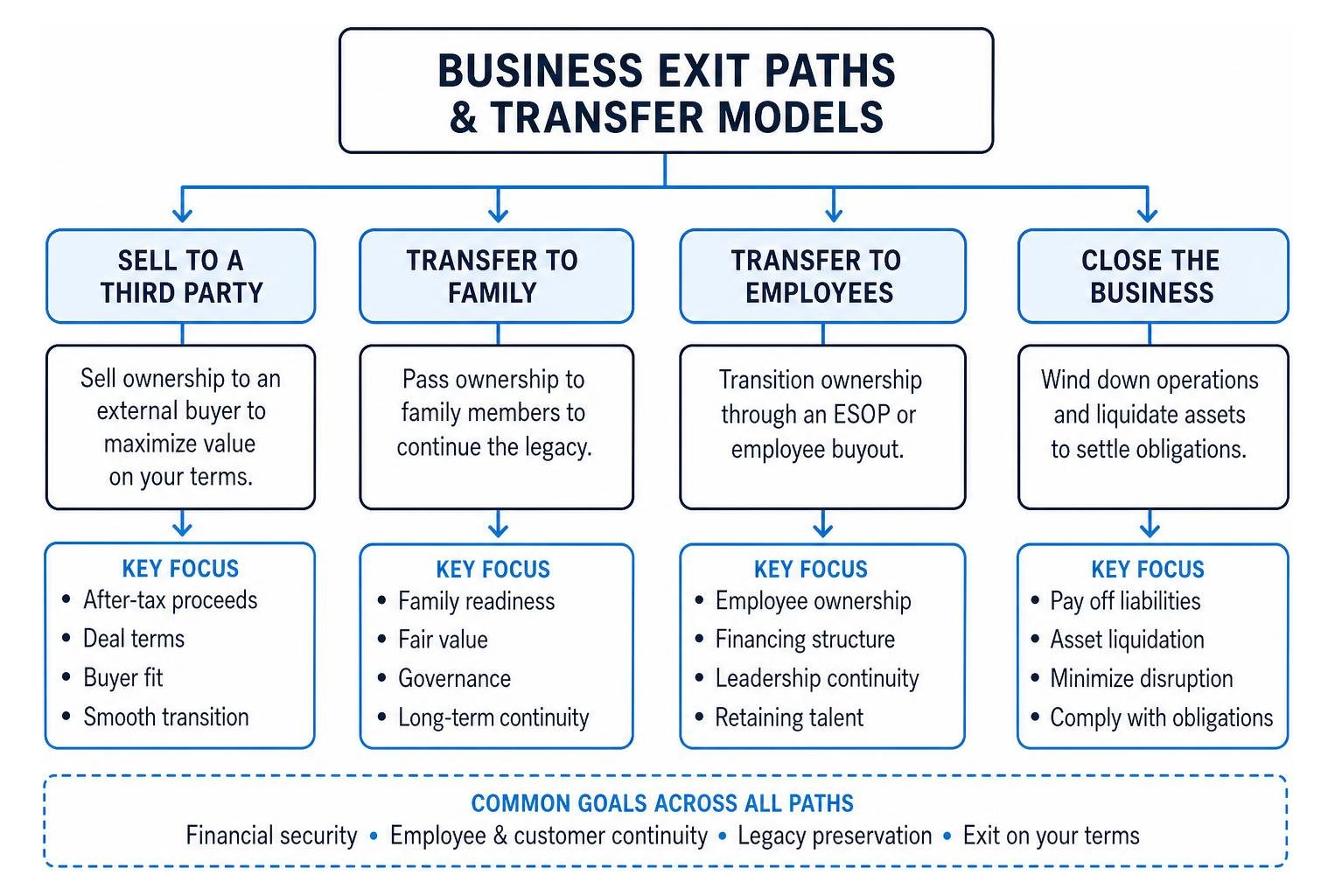
Selecting the ideal transition mechanism requires balancing your financial expectations, personal values, timeline, and tolerance for transaction complexity. No single exit model fits every commercial enterprise, and founders must weigh the trade-offs of third-party acquisitions, private equity partnerships, employee buyouts, and intergenerational family transfers.
Strategic third-party sales frequently yield premium valuations, often commanding a 30% to 50% strategic synergy bonus alongside immediate cash liquidity at closing, though they introduce extensive due diligence scrutiny and potential cultural disruption. Private equity recapitalizations provide substantial upfront liquidity while allowing owners to retain 10% to 30% rollover equity for a second liquidity event, balanced against demanding performance covenants and leveraged growth targets.
Internal transition models offer distinct structural advantages. Employee Stock Ownership Plans (ESOPs) deliver substantial tax benefits under Section 1042 and maintain company culture, although they require ongoing regulatory compliance and take several years to fully implement. Management buyouts ensure seamless leadership continuity with minimal confidentiality risks, though secondary leaders often require seller financing. Finally, family succession transfers preserve multi-generational legacy through tax-efficient gifting strategies, but require careful navigation of emotional dynamics and operational readiness among heirs. Evaluating these mechanisms early ensures you select an approach aligned with your post-exit lifestyle and wealth objectives.
Strategic Value Drivers: Maximizing Enterprise Worth Before Sale
Acquirers evaluate businesses based on risk-adjusted cash flow, looking closely at how reliably profits will continue once the founder steps away. Maximizing enterprise value requires shifting your focus from top-line revenue volume to sustainable profit quality, gross margin expansion, and high customer retention.
Focusing on client retention delivers outsized returns; almost 64 percent of shoppers spend more to maximize rewards from a brand’s loyalty program, underscoring how structured retention models enhance lifetime customer value. Simultaneously, mitigating customer concentration is essential, as having any single customer account for more than 15% to 20% of your total revenue introduces substantial perceived risk that causes buyers to discount your valuation multiple. Business owners who proactively pursue strategic business growth by cultivating recurring revenue streams, expanding gross margins, and diversifying their client base routinely command valuation premiums that are 30% to 50% higher than unoptimized industry peers.
Financial Readiness and Quality of Earnings
The financial foundation of any successful transition rests on pristine, transparent accounting records. Savvy acquirers and institutional investors will systematically dissect your historical numbers through a rigorous Quality of Earnings (QofE) review, which strips away non-operational anomalies, discretionary owner perks, and one-off revenues to determine your true adjusted EBITDA.
If your financial reporting is disorganized, or if your books mix personal expenses with corporate outlays, potential buyers will lose confidence, delay closing, or re-trade the purchase price downward. By securing comprehensive business valuation services several years ahead of your planned transition, you can identify accounting discrepancies, normalize operational adjustments, benchmark your multiples against prevailing market conditions, and eliminate diligence surprises before buyers ever review your data room.
Operational Transferability and Reducing Founder Dependence
A business that cannot run without its owner is not an asset; it is simply an exhausting job with commercial overhead. Acquirers pay significant premiums for turn-key operational engines that feature documented Standard Operating Procedures (SOPs), cross-trained staff, portable vendor agreements, and empowered operational leadership.

When every critical decision, key vendor relationship, and major sales conversion depends exclusively on the founder’s daily presence, buyers introduce aggressive earnout structures or steep purchase price discounts to offset the operational risk. Decentralizing management authority, delegating primary client relationships to key account managers, and formalizing delivery workflows proves to investors that corporate performance will continue uninterrupted after ownership changes hands.
The Multi-Year Roadmap to Building an Exit Plan
Executing an optimal business transition is an operational project that requires structured milestone tracking, rigorous gap analysis, and disciplined execution over an extended timeline. Treating your exit as an intentional multi-year initiative ensures that your capital structure, tax posture, and operational capabilities mature in tandem.
Founders who formalize their strategy using proven written frameworks for exit strategy business plans consistently realize 15% to 30% more in net transaction proceeds than those who rely on informal assumptions. A structured document translates overarching retirement and liquidity aspirations into concrete, accountable milestones with designated budgets and completion deadlines.
Core Components of a Comprehensive Exit Strategy Planning Document
A written exit plan serves as the master blueprint guiding your executive team and outside advisors through the preparatory years. It systematically closes the gap between your current business valuation and your required net wealth targets.
Every comprehensive exit planning document contains several foundational elements that align business operations with your financial goals. First, it defines your vision and personal wealth targets by establishing clear financial thresholds, targeted transition dates, and desired post-sale involvement. Next, a thorough current state assessment incorporates normalized trailing three-year financial statements, balance sheet summaries, and baseline market valuations. The plan also includes a value driver and gap analysis that audits current profit margins, recurring revenue streams, customer concentration levels, and management depth against industry benchmarks.
To execute the transition effectively, the document details an operational action plan with specific projects designed to eliminate bottlenecks, clean up accounting records, and strengthen secondary leadership. Additionally, an advisor roster and diligence checklist outlines the responsibilities of legal counsel, accounting professionals, and wealth managers alongside a complete virtual data room index. Finally, contingency playbooks establish legal frameworks for funded buy-sell mechanics, key-person insurance policies, and interim leadership protocols in the event of unexpected owner incapacitation.
Managing this multi-faceted document alongside regular commercial operations often strains internal executive resources. To maintain momentum, many growing enterprises partner with professional fractional CFO services to institutionalize financial controls, model cash flows, monitor gap metrics, and guide executive decisions leading up to the transaction.
The 3 to 5 Year Transition Timeline
A realistic transition lifecycle spans several distinct phases, each focused on specific operational and financial objectives that build upon one another to maximize transaction value.
During the initial phase, three to five years before your anticipated transaction, you establish baseline valuations, remediate accounting inconsistencies, and address balance sheet inefficiencies. Two to three years out, the focus shifts toward delegating daily operations, documenting standard operating procedures, and diversifying customer accounts to minimize owner dependence. In the final twelve to twenty-four months, you assemble your advisory board, populate a secure virtual data room with auditable contracts and tax filings, initiate a competitive auction or internal transfer process, and manage deal negotiations through to formal closing and post-sale integration.
Managing Risk, Taxes, and Wealth Preservation
A headline transaction figure is merely an optical milestone; the only metric that truly determines your future financial security is the net cash remaining in your wealth accounts after taxes, debt settlements, escrow holdbacks, and transaction fees. For example, on a business generating $1 million in annual revenue, an owner should expect to pay up to $150,000 for a successful sale when accounting for specialized legal counsel, accounting audits, broker commissions, and administrative fees.

Proactive wealth structuring requires coordinating your transaction architecture with your long-term estate and asset-protection plans. Aligning corporate legal structures with appropriate personal trusts and investment vehicles guarantees that your liquidity event converts smoothly into lasting generational wealth.
Integrating Involuntary Contingencies into Exit Strategy Planning
While most entrepreneurs envision an orderly, celebratory retirement, life frequently introduces disruptive circumstances. Exit strategy planning must account for the five classic involuntary triggers: death, disability, divorce, partner disagreement, and personal distress or burnout.
Failing to establish contingency protocols leaves your enterprise vulnerable to operational gridlock or forced asset fire sales. A well-constructed strategy incorporates funded buy-sell agreements that outline clear valuation formulas and payment terms among surviving partners. Backing these agreements with robust key-person life and disability insurance policies ensures that the company or surviving shareholders possess immediate liquidity to buy out equity from heirs without draining operational working capital.
Tax Optimization and Post-Exit Wealth Structuring
The tax code provides several powerful mechanisms for business owners who plan ahead, but these strategies generally require proper structural setup well before signing a definitive purchase agreement. Large, unoptimized asset sales executed within a single calendar year can trigger significant capital gains liabilities, state tax assessments, and net investment income taxes that needlessly erode enterprise wealth.
Entrepreneurs operating qualified C-corporations may take advantage of Qualified Small Business Stock (QSBS) provisions under Section 1202, which can exempt up to $10 million or ten times the adjusted basis in capital gains from federal income tax if holding period criteria are met. Additionally, structuring transactions through installment sales, utilizing charitable remainder unitrusts (CRUTs), transferring non-voting shares into irrevocable gift trusts, or implementing advanced retirement structures can dramatically reduce total tax burdens. Business owners should also evaluate retirement vehicles; for 2024 tax filings, owners could contribute up to 25% of compensation or $69,000 into a SEP-IRA or Solo 401(k), while SIMPLE IRA and SIMPLE 401(k) limits allowed contributions up to $16,000, offering valuable avenues for sheltering pre-deal income. Integrating proactive tax planning strategies years before an exit guarantees that you legally minimize your tax liability while maximizing post-transaction liquid wealth.
Assembling Your Advisory Board for Transaction Success
Navigating a corporate transaction requires a coordinated team of specialists. Industry studies show that 80% of companies seek assistance from advisors outside the firm for business transitions, recognizing that negotiating against seasoned private equity buyers or corporate acquisition teams requires dedicated technical expertise.
Your advisory board should include a corporate transaction attorney experienced in M&A deal structures, an experienced transaction CPA, a licensed business broker or investment banker, and a certified wealth manager. Working with established fiduciary investment firms ensures that your post-sale asset allocation aligns with your cash flow needs, philanthropic goals, and estate distribution plans without introducing conflicts of interest.
Aligning CPAs, Legal Counsel, and M&A Advisors
Disjointed advice among your professional team can delay deal progress, create costly structural oversights, or lead to deal fatigue that causes buyers to walk away. Your M&A advisor focuses on marketing the company, creating competitive buyer tension, and negotiating headline terms; your transaction attorney drafts defensive purchase agreements, manages indemnification provisions, and limits post-close liabilities; and your CPA verifies working capital targets, ensures tax-efficient asset allocations (under Section 1060), and models net cash proceeds at various deal structures.
Holding regular synchronization sessions among your core advisors ensures that legal contracts mirror accounting realities and that deal structures support your personal financial goals. This interdisciplinary alignment gives you maximum negotiating leverage, closing certainty, and peace of mind from letter of intent through final fund distribution.
Frequently Asked Questions About Exit Strategy Planning
How far in advance should I start planning my business exit?
You should begin exit strategy planning ideally three to five years before your anticipated transition window. This multi-year runway gives you adequate time to clean up accounting records, resolve customer concentration risks, build an autonomous management team, and optimize your corporate tax structure. If you need to exit more quickly, engaging specialized advisors twelve to twenty-four months in advance still allows you to address major diligence vulnerabilities and prepare a clean virtual data room.
What is the difference between a voluntary and involuntary exit plan?
A voluntary exit plan is a proactive roadmap designed around your personal retirement timing, target wealth goals, chosen succession method, and preferred post-sale lifestyle. An involuntary exit plan is a defensive risk-management framework that prepares the business for unexpected disruptions such as sudden illness, permanent disability, partner disputes, divorce, or untimely death. Every resilient business requires both plans to protect operational continuity, enterprise value, and family financial security under any circumstance.
How do buyers calculate business valuation multiples during an exit?
Acquirers calculate valuation multiples by benchmarking your normalized, adjusted EBITDA (or Seller’s Discretionary Earnings for smaller owner-operated firms) against prevailing industry transaction comps. Multiples typically range from 3.8x to 5.2x SDE for small service businesses, and from 5.0x to 8.0x+ adjusted EBITDA for lower-middle-market manufacturing, technology, and healthcare companies. Buyers then adjust this multiple upward or downward based on your revenue growth rates, profit margins, recurring revenue stability, management depth, and customer concentration risks.
Conclusion
Exiting your business is one of the most consequential personal and financial milestones you will ever navigate. The decisions you make during the planning phase will directly determine whether you walk away with maximized after-tax wealth and preserved relationships, or leave substantial enterprise value on the closing table.
At Spitz CPA, we work alongside business owners to provide the financial clarity, operational rigor, and accounting discipline required to navigate complex transactions. Guided by the extensive corporate finance, M&A due diligence, and tax structuring experience of Michael J. Spitz, our team helps you transform your company into a highly transferable, valuable commercial asset. Whether you plan to sell in three years or transition leadership to family members a decade from now, exploring our comprehensive accounting services is the first decisive step toward unlocking your company’s full market potential and securing your personal financial legacy.


